How to Draw a Circular Hopi Tapu'at Labyrinth

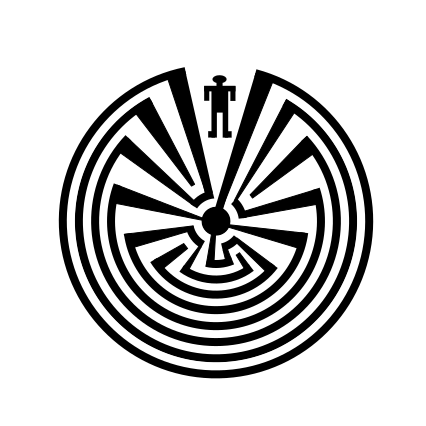
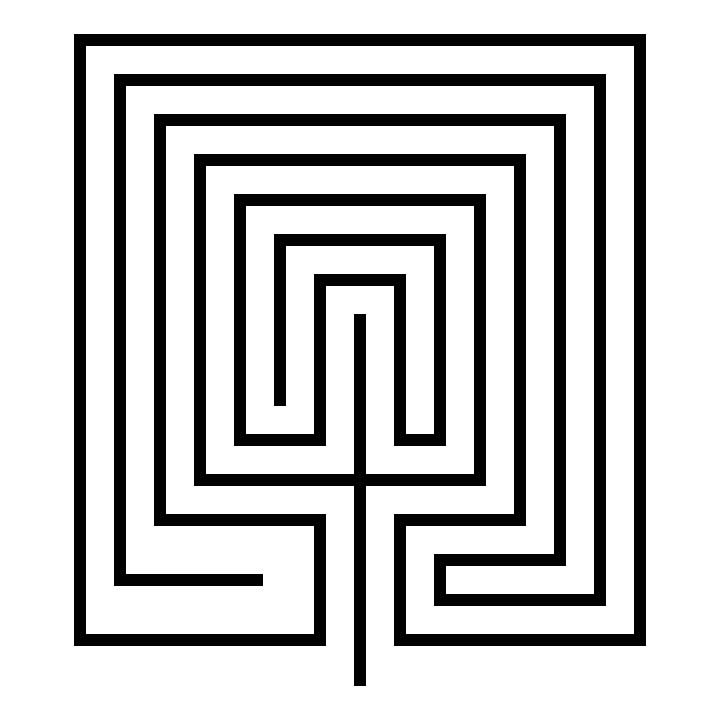
I have previously shown how to make a Square Hopi Tapu'at Labyrinth and today I will show you step by step how to make the circular version. Let’s look at the 2 side by side and compare them.

Circular Hopi Tapu'at Labyrinth
Circular Hopi Tapu'at Labyrinth

Square Hopi Tapu'at Labyrinth

Square Hopi Tapu'at Labyrinth

The interesting thing about these is that they are so different. The square version has 2 entrances and 2 goals, while the circular has one of each. Obviously there is also the overall shape and corner shapes apparent in the individual names.

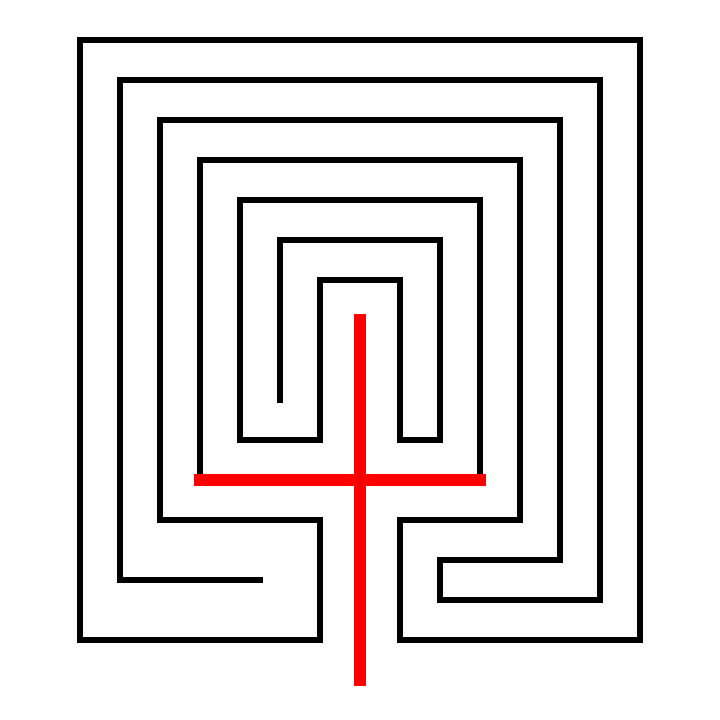
When I made my circular version I noticed that it did not fit into the typical labyrinth making process. I have a potential usable seed pattern, but each step is more complex than normal. I also noticed that the labyrinth is a series of (mostly) vertical straight lines and half and quarter circles. Let’s explore this with a diagram I made to show what makes up the labyrinth and compare it to the 7 circuit classical labyrinth:

Hopi Tapu'at Labyrinth: Everything in red is a straight line. Everything is black is either a half circle or a quarter circle. This is a right handed labyrinth (first turn is to the right).

Classical Labyrinth: Everything in red is a straight line (basically just the seed portion minus the dots). However the black portions are not perfect circles. When you make this labyrinth you are connecting points with curved lines. This is a left handed labyrinth (first turn is to the left). This can be made right handed, but left handed is typical.

Circular Hopi Tapu'at Labyrinth seed pattern  ?

I trial and errored the making of this labyrinth. It is complicated. So, while it is not ideal, I am going to use this very large seed pattern. Otherwise, each step is complicated. So the most difficult part of this is creating the seed pattern correctly. Smooth sailing from there !

For this labyrinth I will be drawing each step in red on top of a completed labyrinth with thin lines to show you where that step is located in relation to the completed labyrinth. After each step the previous steps lines change to black from red.

Step 1: Draw the starting seed pattern.

I included the grid in this example to show you how to draw this seed pattern. It is the most complicated I have ever used. Start with a plus sign. The horizontal is 8 units long, while the vertical line is 6.5 units long, 3 units below and 3.5 units above that line. At the end of each side of the horizontal line draw a 4 unit vertical line. Beside the left line you just made add 4 lines to the left, all 4 units long. Make sure they are equidistant apart. On the right side do the same thing but with only 3 additional lines instead of 4. Now you can fit 3 vertical lines on the right side, 2 grids long and aligned t the top of the just made 4 grid lines. Moving to the left side you will do the same thing with 1 exception, the line just to the left of the top of the plus sign should aligh with it at the top (1.5 grids instead of 2). Next under the horizontal line, aligned to each end you will draw three 2 unit long horizontal lines ( 6 total lines). And finally the last line of this complicated seed is a horizontal line on the left side, aligned with the previously 3 on the left but draw 3 grids long instead of 2.

Circular Hopi Tapu'at Labyrinth seed pattern

Step 1 - Circular Hopi Tapu'at Labyrinth

Step 2: Draw the Goal

Between the two short lines in the center draw and arch to connect them. Teh top of the arch should align with the top of the vertical lines on its left and right.

Hopi Tapuat Mother Child Birth Circular Labyrinth step 2

Step 2 - Circular Hopi Tapu'at Labyrinth

Steps 3-9: Create the top arches

These are all the same maneuver and so they get bunched into 1 explanatory step. Create a semi circle to connect the top of the end of the next inner line on the left to the line on the right. The peak should align to the peak of the goal. Essentially you do this 7 times to create the top of the labyrinth ! Shown here as a rainbow; start with purple, then blue, etc.

Hopi Tapuat Mother Child Birth Circular Labyrinth steps 3-9

Steps 3 - 9 - Circular Hopi Tapu'at Labyrinth

Steps 10/11: Connect the internal turns

You should have 2 empty spaces to fill in the center of the labyrinth on either side below the goal, each has 3 vertical lines. Take the end of the 2 outside lines on each side and connect them with an upside down arch. Shown in red and blue below.

Hopi Tapuat Mother Child Birth Circular Labyrinth steps 10 & 11

Steps 10/11 - Circular Hopi Tapu'at Labyrinth

Steps 12-15: Draw the left corners

On the bottom left connect the end of each vertical line with the end of each horizontal line working you way from inside out. Each of these is a quarter of a circle, or arch. In order, red, blue, green, yellow below.

Hopi Tapuat Mother Child Birth Circular Labyrinth steps 12-15

Step 12-15 - Circular Hopi Tapu'at Labyrinth

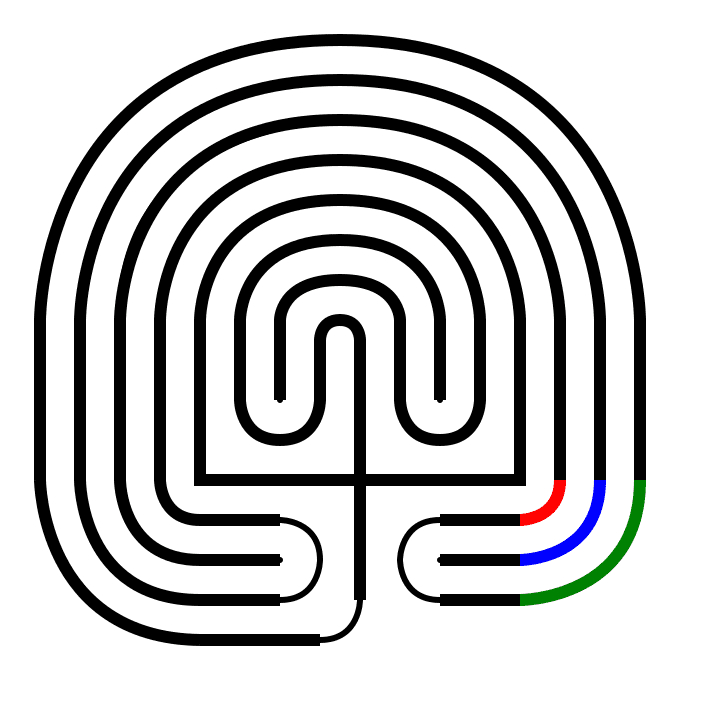
Steps 16-18: Draw the right corners

Same as above but on the right side, and only 3 times, shown as red, blue and green below.
Hopi Tapuat Mother Child Birth Circular Labyrinth steps 16-18

Step 16-18 - Circular Hopi Tapu'at Labyrinth

Steps 19 - 21: Close the outer pathways

On the bottom left you should have 3 horizontal lines of the same length (the southernmost line is slightly longer). Connect the 1st and third with a semi-circle to create a turnback pathway (shown below in red). Do the same thing on the right side opposite (in blue). And our final step is completing the labyrinth by connecting the bottom of the plus sign with the end of the horizontal line on the left with a quarter circle (shown in green).

Hopi Tapuat Mother Child Birth Circular Labyrinth steps 19-21

Step 19-21 - Circular Hopi Tapu'at Labyrinth

That completes the labyrinth.

Circular Hopi Tapu'at Labyrinth

Circular Hopi Tapu'at Labyrinth

How to Draw a Square Hopi Tapu'at Labyrinth

You might have noticed on my How to Make a Labyrinth section of the site I have a section titled Other /Experimental Labyrinths. The first labyrinth included in this section is the Man in the Maze labyrinth, a Native American symbol from the Tohono O'Odham nation. Learn details about it on this blog, or on Wikipedia, or from this article. Below is one I made digitally.

Man in the Maze Labyrinth

I wanted to do a step by step How - to for creating it, but realized as I made it…there was not an easy way to do that. Essentially it is a “copy what you see and good luck” situation. My trial and error included a lot of both. Today I want to explore the making of another Native American Labyrinth, the Hopi Tapu'at Labyrinth, and specifically the square version. As I researched how to explain this labyrinth I realized an expert could do it much better, here is Julie Bounford, from her website.

“The mythology of the Hopi of northern Arizona features labyrinths. Most well-known is the Tapu’at, the “Mother and Child” symbol. Both the circular and square forms represent the womb of Mother Earth, the divine birth-giver. The circular in particular is said to represent the road of a human life. In following it, one attains spiritual rebirth. From early on, the labyrinth has been associated with death and rebirth. In death, one returns to the earth (the eternal mother), from which one is reborn. ”
— Julie Bounford

This is a 9 step process, and while I will make it digitally, giving it a ‘clean’ look, it is typically hand drawn and so more natural looking. Let’s get started.

For this labyrinth I will be drawing each step in red on top of a completed labyrinth with thin lines to show you where that step is located in relation to the completed labyrinth. After each step the previous steps lines change to black from red.

Step 1: Draw the starting seed pattern.

The starting seed pattern for this labyrinth is an off-center plus sign. The horizontal line is 7 units on a grid, 4 on the left 3 on the right of the vertical line made of 9 units, 4 above the horizontal, and 5 below.

Square Hopi Tapu'at Labyrinth seed pattern

Step 1 - Square Hopi Tapu'at Labyrinth

Step 2: Draw the first layer

Above the top of the plus sign create an upside down U shape that extends out to the left and right 1 unit less than the horizontal lines. See below.

Hopi Tapu'at Labyrinth step 2

Step 2 - Square Hopi Tapu'at Labyrinth

Step 3: Create the Inner Goal

Create the inner goal by drawing from the previous steps right side around the structure counterclockwise making an upside down square shaped U. There are actually 2 goals in this labyrinth which I will discuss below.

Hopi Tapu'at Labyrinth step 3

Step 3 - Square Hopi Tapu'at Labyrinth

Step 4: Draw the next level

Connect the right side of the horizontal line in the plus sign counterclockwise to the end of the northernmost horizontal line (created in Step 2) to close off the pathway. Again you have just made an upside down square shaped U.

Hopi Tapu'at Labyrinth step 4

Step 4 - Square Hopi Tapu'at Labyrinth

Step 5: Draw the next level

This time we are drawing clockwise, connecting the left end of the initial plus sign around the outside creating our familiar upside down square U shape but continuing it to left ( but not closing it off completely). See below.

Hopi Tapu'at Labyrinth step 5

Step 5 - Square Hopi Tapu'at Labyrinth

Step 6: Draw the next level

This is a long one. Start with an upside down reverse L shape in the lower right plus sign that starts one units or grid up from the bottom of the plus sign. Then continue by drawing your familiar U shape clockwise. End the line on the right side with a horizontal line that stops one unit or grid before the end of the line just inside it. That’s a long one. See below.

Hopi Tapu'at Labyrinth step 6

Step 6 - Square Hopi Tapu'at Labyrinth

Step 7: Draw the outer goal

The next layer starts equal to the end of the bottom left corner and follows clockwise all the way around to the bottom right corner. Continue the line left until it moves north 1 unit to close off the previous section and create the outer goal.

Hopi Tapu'at Labyrinth step 7

Step 7 - Square Hopi Tapu'at Labyrinth

Step 8: Draw the outer wall

This step completes the outer wall, but not the total labyrinth. Draw a line starting in the bottom right side centered in the last gap to complete the right entrance. Then follow the outside wall around…until you get to the bottom left corner. Here you need to draw the final wall equal to the wall on the right side. This creates a larger gap than normal above it.

Hopi Tapu'at Labyrinth step 8

Step 8 - Square Hopi Tapu'at Labyrinth

Step 9: Complete the labyrinth
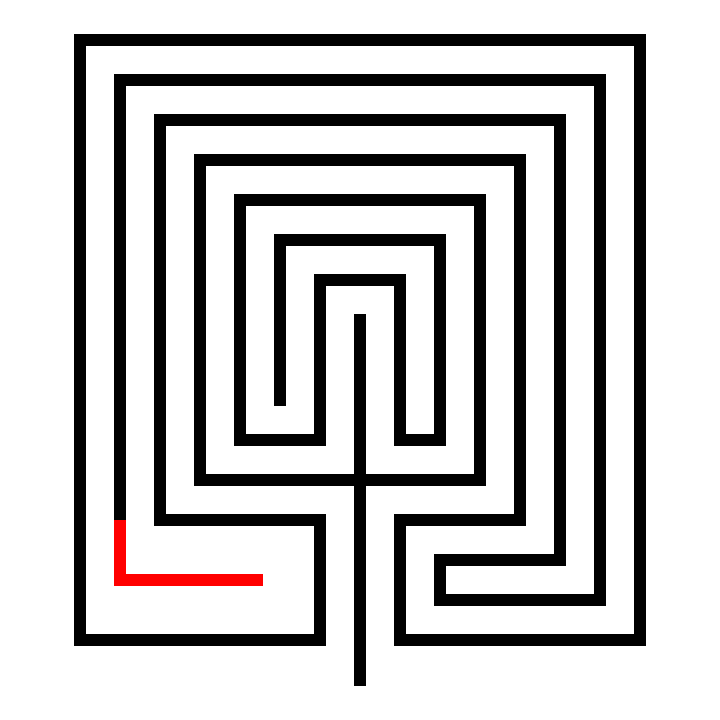
This last step creates a pathway and walls that is not equidistant like the previous steps. The final L shape you draw should be centered between the 2 bottom walls and connect to the end of the last line.

Hopi Tapu'at Labyrinth step 9

Step 9 - Square Hopi Tapu'at Labyrinth

That completes the labyrinth.

Square Hopi Tapu'at Labyrinth

Square Hopi Tapu'at Labyrinth

2 Entrances - 2 Goals

This labyrinth has 2 entrances and 2 goals. The left entrance, the Mother, is the outer labyrinth, which encapsulates the inner Child section that is reached from the right entrance. I have colored the two labyrinths sections to better show this concept, in blue and yellow below:

Square Hopi Tapu'at Labyrinth Mother and Child shown

Alternative Seed Pattern: I hesitate to call this a seed pattern since it is complicated. But it works similar to other seed patterns for labyrinths. IF you start with this pattern the next 7 steps are connecting points to points. Here it is in Red.

Square Hopi Tapu'at Labyrinth alernative seed pattern

If you are interested in how to make the circular version drop me a note. It is difficult but not Man in the Maze difficult ! Here is my digital drawing of it.

Hopi Tapuat Mother Child Birth Circular Labyrinth

Circular Hopi Tapu'at Labyrinth

12 Maze Art Ideas : Unlocking Creative Possibilities

I love to make maze art. I have found my niche with maze art of buildings and signs. I have experimented with a few other ideas that I will list below, but they are not my go-to. I think about what subjects to make mazes of a lot and below is a list of some of my ideas. Some of these are things you have most likely thought of and others might be considered ‘out there’. I’m just here to spark an idea in you that may not even be on the page. Maybe it inspires some new maze art techniques that advance the possibilities of what can be done.

12 Maze Art ideas

1 - Landscape Mazes

I have experimented with this a few times. I think my takes on landscape mazes have been average. For me I have trouble ‘locating’ the maze in the landscape if that makes sense. A landscape of nature - a lake, mountain, a forest all seem interesting. A natural start and goal could be a cabin, a boat, or a mountain peak. Here is one of my attempts of a cliff dwelling:

Cliff Dwelling Mesa Verde National Park Maze

Cliff Dwelling Mesa Verde National Park Maze

2 - Scene Maze

I have just started experimenting with scene mazes. For me it has been inspired by my time living in Mexico. I have done a street scene (shown below) that highlights the beautiful color buildings you find in Mexico. I am working on a scene of a Mexican door/house front. I have started making a scene of steps that lead to a church. What about a mercado ? A street festival ? So many interesting possibilities. An amusement park…

QRO Walking Street Maze

QRO Walking Street Maze

3 - Map Maze

The best map mazes are done the maze artist Ben Uelk. I think the structure of maps and the way cities are constructed make for natural maze possibilities. My own experiment led me to make a maze from the NYC Subway map. You can use the grid-like map of a cities road as pathways. One way streets could be used as conditional pathways. Maze maps can creatively include items or landmarks from the mapped area, used as the start and goal or as conditional points that need to be visited while solving the maze.

4 - Skyline Maze

My return to making mazes as an adult was led by a maze I made in Microsoft Excel of a skyline of buildings. I called it “Lost in the City”. While this did not represent a specific city (though it was inspired by NYC) the idea has always stayed with me. I remember a time when long skyline posters were popular of cities (maybe they still are?). Buildings make a great subject matter for mazes - so why not a large amount of buildings that are connected by maze pathways (like a cities worth) !

City skyline Maze

City skyline Maze

5 - Insect Mazes

Insects are small but complex beings. When you zoom in on them, you get a surprising number of legs, antennae, interesting eyes (think about the yes of flies), sometimes some wings, and a range of colors not normally seen by the naked eye. The detail that can be brought to something that isn;t seen with detail can be interesting (and terrifying!). Check out these excellent mazes from maze artist K Lars Lohn : a Spider maze and Bee maze.

6 - Portrait Mazes

I have mentioned it before - it is really difficult to draw the human face. If you have the ability to do it, and can make mazes of famous people, I want to see it ! I know how hard it is ! The closest I have come is with my Abe Lincoln statue maze which isn’t even that close, but hey it includes a recognizable face !

Abraham Lincoln Statue Maze

Abraham Lincoln Statue Maze

7 - Famous Art Mazes

I have 2 ideas here. 1 - In the style of - A maze in the style of Picasso, or Monet, or you pick your favorite artist. I like the number of directions this can take - abstract, surrealism, impressionism, realism, pop art, and more. 2 - Remake a specific piece - there are copyright issues here so de careful, but a maze of a famous piece of art would be epic. Mona Lisa Maze. The Starry Night Maze. The Scream Maze. American Gothic Maze. and so many more possibilities ! Here is my very basic tribute to Piet Mondrian:

Piet Mondran Tribute Maze

Piet Mondran Tribute Maze

8 - Rube Goldberg Machine Maze

I love a good Rube Goldberg set-up. And I have been thinking about making this maze for awhile. I thought about keeping this for myself, but I included it because I want to see it and I think it would be so cool that there is room multiple mazes of this ! If you are reading this…uh ? try it ? Like this maze would be epic ! I imagine start at the top of the page in a marble and a maze that roughly follows its path down thru obstacles ending at the bottom with a _____? Epic.

9 - Experimental Mazes

When I used to do monthly maze themes, I liked to experiment with maze constructions. THese included 3D Mazes, connected mazes, warp zone mazes, multiple versions of mazes within a maze. All of the mazes I made were ‘regular looking’ mazes, and none were attempted as recognizable items/artwork but more at the level of an everyday puzzle you would find in a book. But pushing these experiments to maze art levels would definitely be possible (but difficult) ! Here is my 3D Arrow Maze.

3D cube shaped Arrow Maze

3D cube shaped Arrow Maze

10 - Comic Book Maze

Another experimental set of mazes that is on my to-do list but I have not attempted for years. Create a comic book story. A mystery. Each comic book page has a maze that starts on the cover. The maze continues through the entire book. In the last section of the book, the maze leads to the story conclusion - possibly with multiple endings and the maze pathway you take gives you a different ending.

11 - Collaboration Mazes

I have done a few of these with my friends based off of their artwork. Some day I hope to share a few mazes with others. I did an Abraham Lincoln maze based off of some artwork I found online. When I saw Lincoln I knew he would make an interesting template for a maze. I went with a vertical maze construction. In this case the clipart was in the public domain, but you can be more intentional ! Thank you to Karen Arnold for the great face of Abe !

Abraham Lincoln face maze

Abraham Lincoln face maze

12 - Weaving Pathway Mazes

When it comes to maze construction one of the things that tends to be static is the type of pathways. Some of my favorite maze artists (like Frankie C and theLadyLabyrinthe) use pathways that weave over and under one another. This makes for a more fun, but difficult maze to solve. It is clearly not right for most mazes, but when you find things in nature - trees, bushes, flowers, etc. they make great canvases to try using a weaving maze pathway on.

I had considered adding 3D mazes to the list, but you would need a manner to solve them - digitally with a special program, or with physical mazes. Sounds like a difficult challenge but one worth exploring for the bold.

If you want to get a little help there are some great AI text to image generators that can inspire you also !

Happy maze-ing !

You can invent your own maze types with some help from this 3 part guide:

Part 1 - Options for Starting and Ending a Maze

Part 2 - Maze Pathway options

Part 3 - Conditional Pathway options

And some case studies:

Using Color for Maze Pathways - A Case Study

Maze Design Case Study - Designing a Grid Maze in Different Difficulty levels

Twisty Little Paths: Creating New Types of Experimental Mazes

I spent an entire month making Experimental Mazes were I came up with 11 different types of mazes. Each type had at least one daily maze posted on the site and some of these experiments had up to 5 different versions. Today I want to pull each of these new maze creations together and review them, see how I did, what worked and get some feedback from you.

Part 1 - Perspective Arrow Maze

This idea is pretty simple: Arrow Maze + a change in perspective. I did 5 different versions and below is my favorite example. A typical Arrow Maze is flat and I thought adding some perspective would be interesting. I enjoyed making this and getting the maze aligned as I made it in sections.

Perspective Arrow Maze

Perspective Arrow Maze

Part 2 - Multi Arrow Maze

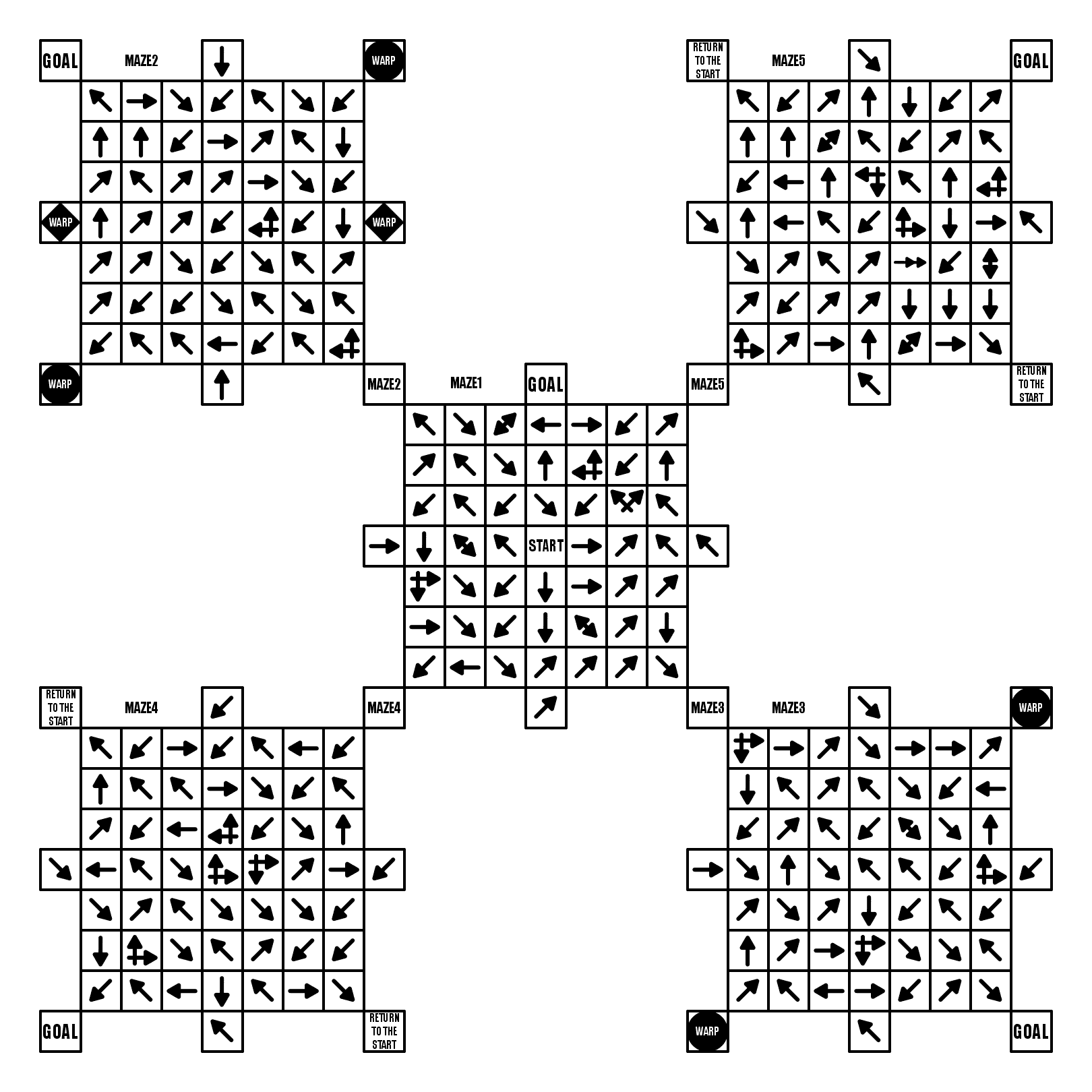
This idea is connected Arrow Mazes. Day 1 is Arrow Maze 1 you solve normally. Day 2 adds Maze 2 (the upper left corner). The solver starts in the same place, but tries to reach the Day 2 Goal in Maze 2. This continues each day. Day 3 adds Maze 3 and a new GOAL. By day 5 you have 5 Arrow Mazes combined into one. Can you solve each maze in order ? Good Luck. To clarify, landing on a corner of the center arrow maze opens up the new maze section to you.

Multi connected Arrow Maze

Multi Arrow Maze

Part 3 - Color Grid and Grid Maze Combo

Another combination maze, this one featuring a color grid maze and a grid maze. Since the Color Grid is already “gridded” this made it easy to create a 2-in-1 maze. Solve the 2 mazes in any order. In this case the start and goal is the same for each maze type.

Color Grid and Grid Maze Combo

Color Grid and Grid Maze Combo

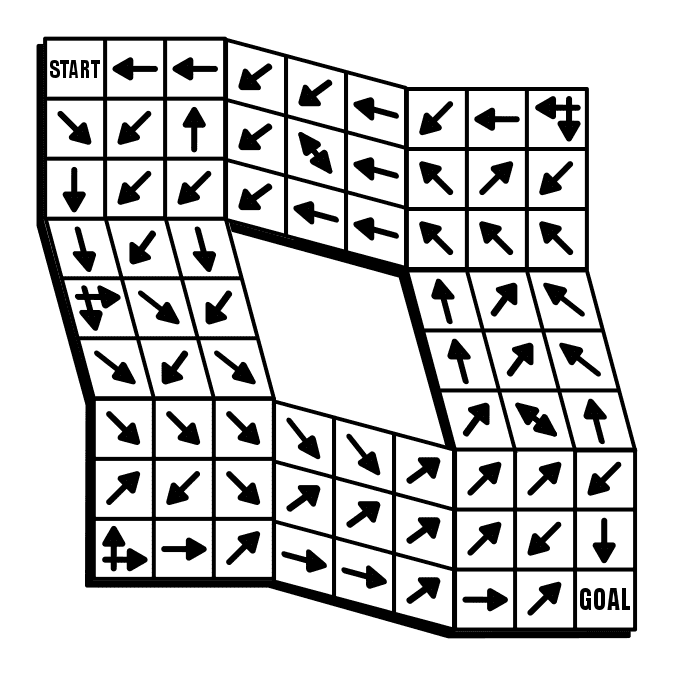
Part 4 - Folded Grid Maze

A Grid Maze that has the appearance of being a folded piece of paper based on changing the perspectives on a few sections. I did 2 versions. Easy to make. Looks more interesting than a regular grid maze, but is nothing earth shattering.

Folded Grid Maze

Folded Grid Maze

Part 5 - Layered Grid Maze

A Grid Maze that uses multiple layers to give the maze a more interesting look. Honestly, this is not very experimental in hindsight. It looks marginally more interesting, but at the end of the day is still just a grid maze.

Layered Grid Maze

Layered Grid Maze

Part 6 - Arrow and Grid Maze Combo

Another 2-in-1 maze experiment. This one combines the Arrow and Grid Mazes. I made it to be solved Arrow Maze first, then Grid Maze after, returning to the original start, but you can technically solve in either order. I like the idea of the start of one is the goal of the other. I did 4 different mazes of this type.

Arrow Maze Grid Maze Combo

Arrow Maze Grid Maze Combo

Part 7 - The Sectional Maze

A Sectional Maze uses lightly connected sections and weaving pathways to travel throughout the maze. Nothing too crazy, but a new type of maze for me. Maybe the newest portion is the one way pathways between sections. I feel like this is a small version of something much larger and more interesting.

The Sectional Maze

Sectional Maze

Part 8 - Standard Perspective Maze

A standard maze where I have played with the perspective. I think this is the least appealing maze I made playing with perspective. Boring in this example and possibly boring in most examples. When I originally thought of it I was thinking it would look like a folded piece of paper. This particular example is also a Kids maze.

Standard Perspective Maze

Standard Perspective Maze

Part 9 - Stacked Grid Maze

A Grid Maze (blue) inside a grid maze (black). Day 1 included only the black walls, while Day 2 uses both black and blue to create the walls. I stopped after 2 days as the solution stays generally the same on day 2 in this version.

Stacked Grid Maze

Stacked Grid Maze

Part 10 - Pipes and Arrow Maze Combo

Another 2-in-1 maze that combines Pipe Mazes and Arrow Mazes. These can be solved in any order. I looks a bit odd but these are 2 of my favorite maze types. I will say as a designer this maze type takes a long time to make. If I could make this faster I would make more.

Pipes and Arrow Maze Combo

Pipes and Arrow Maze Combo

Part 11 - Stacked Standard Maze

5 Mazes in 1. Each Day for 5 days I added a new layer to solve. Each smaller arrow adds a new layer of walls to impede you. So the maze starts with black walls only. The next maze on day 2 uses black and grey walls. Then + Blue, + Red, and finally + Green. I thought this was a fun idea. But the actual execution is tough on the eyes and not as enjoyable to solve as I thought. I wonder if wider spacing for all maze pathways would improve it.

Stacked Standard Maze

Stacked standard maze

The odd sizes mean I did not make these mazes into a traditional free downloadable book, but I did gather them into a 31 page booklet. It is not recommended for printing. The download is 392Kb and is best used on screen.

Are there some mazes you like that should be continued and explored ? Send me a request.