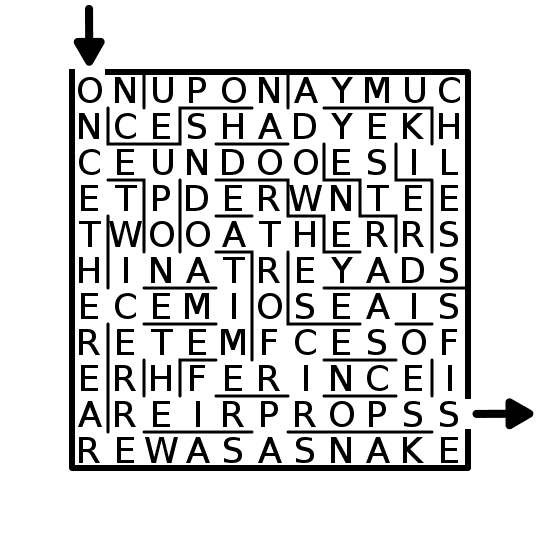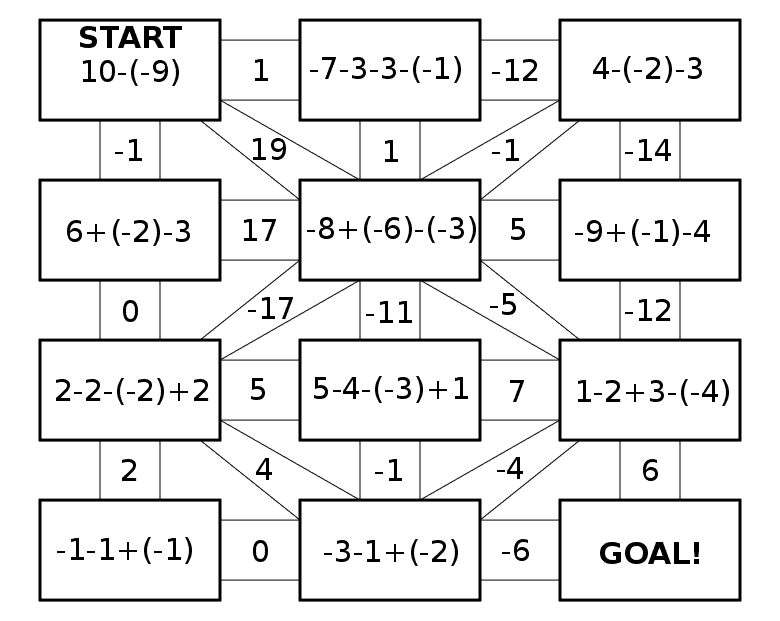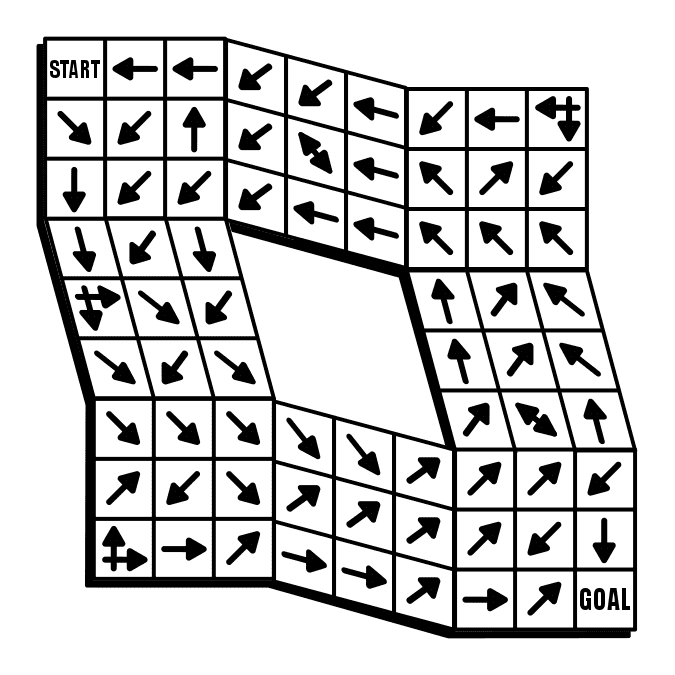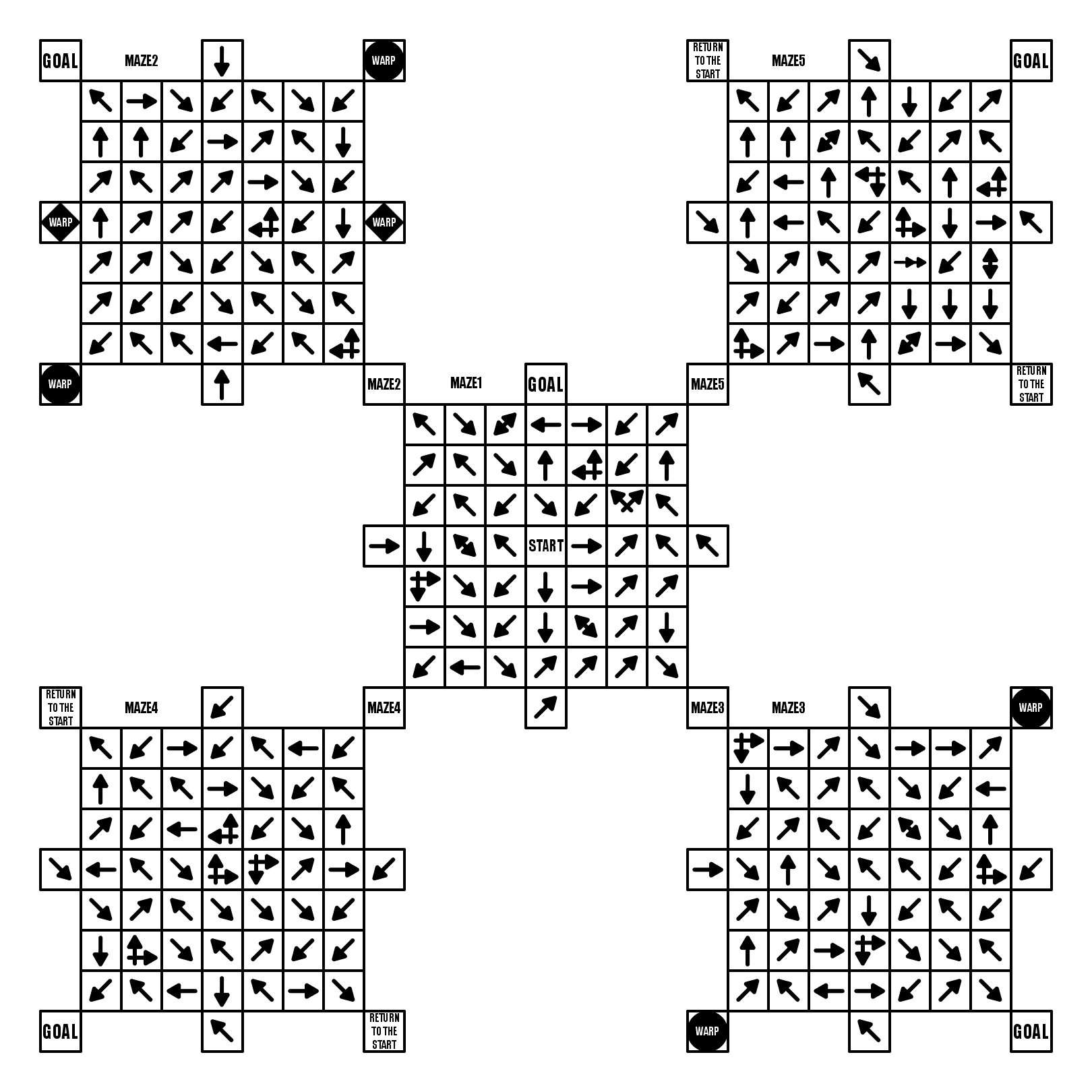
Case Study#4 - How to Improve a Bad Maze - Hollywood

I took the time to evaluate mazes and see why they did not work and try to determine - could they be salvaged ? Today I present my 4th case study for improving one of those mazes, The Hollywood Sign. If you want to read the previous 3 case studies:

Case Study#1 - How to Improve a Bad Maze - Tiki Totem Maze

Case Study#2 - How to Improve a Bad Maze - Danzante Conchero Chichimeca Maze

Case Study#3 - How to Improve a Bad Maze - Red Rocks Amphitheatre Maze

Back to this maze. Here is what I wrote about the maze in a previous post on why it was abandoned:

“Abandoned Maze #1 - The Hollywood Sign Maze

Technically could be considered a finished maze. But it is very boring. Not particularly good. It does not bring a Kondo level of joy. The maze is easy. Could it be salvaged ? Yes, probably with some color and lots of background detail - but once you see a photo of the actual sign and it’s surroundings you notice a lot of rocks/dirt and just a few bushes. The top of the hill has fences, and cellphone towers, etc. So, this COULD be salvaged, but most likely won’t be. Mistake made: Poor subject matter / poor execution

And let’s look at that maze, also known as the ‘before’. SOOOO boring.

Hollywood Sign drawing

This was a tough one. I rated the above maze a 2 out of 10. Here are the changes I made to (hopefully) improve the maze:

1. Color added - The Hollywood letters in white should pop against the background of the hill. So I colored the hill to enable the bright white letters to pop. I did 2 versions of the hill, bright green and a more normal brownish green we need rain color.

2. Tower added - I added a tower to the top of the hill. One of many possible but enough to show what is there. I did not add the fence since most people never notice it.

3. Bushes added - The slope of the hill has many different types of bushes in various shades of green/brown and grey. I added them around the hillside. I also added some outlines of ridges and some dirt trails.

4. Blur - Although when I saved the file as a png it does not save (so I use screenshots instead), I made everything on the hill that is not a letter blurry. The hillside in pictures does not have a lot of definition or detail that is important - it is just there so highlight the sign, so the blurring helps this (I hope).

5. Letter and branding added - Added the name of the maze and added my branding.

6. Sizing Change - Slight change based on how everything looked, I kept the wide shot but gave it a bit more height based on the tower/branding locations. Initial maze was 990 x 360 and is now 990 x 494, so 37% taller.

FINAL THOUGHTS

Better. Maybe this went from a 2 to a 5. A 2 never sees the light of day. A 5 only does if I see a special case for it (like this case study).

And now the “After”. The new maze in 2 colors:
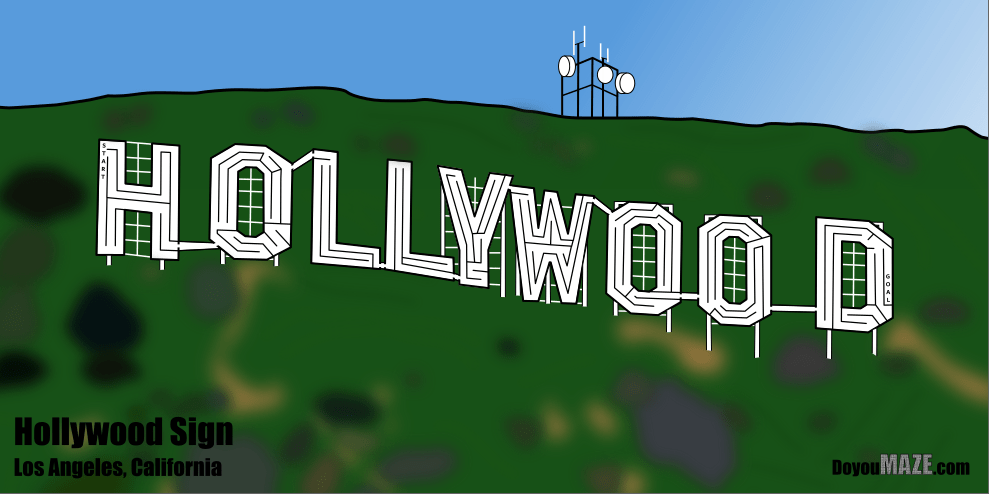
Hollywood Sign Maze
Hollywood Sign Maze alternative color

I think this is an improvement. What do you think ? Do you prefer one green over the other ?

Case Study #1 - How to Improve a Bad Maze

Today I present a case study for improving one of my abandoned mazes, the Tiki Totem Maze which ended up becoming Maze of the Week #86. Here is my analysis from a previous blog:

“Abandoned Maze #4 - Tiki Totem Maze

I thought this would be a good idea. Tiki totems are so cool. I can’t quite put my finger on this. It just isn’t good enough to be on the site as a weekly featured maze. I think it MIGHT be able to be fixed. Add color to the totem, and to make it more interesting - SHADOWS. I would also try a more complex maze structure vs the current kids level format. But I can’t be sure that will be enough…so it will not get done ….or it will. We’ll see. Mistake made: Not enough details / interest”

And I must say, for a maze to be recoverable, the mistake made of not enough details/interest is a giveaway that the maze is salvageable with some additional work. Now let’s look at that original maze, also known as the ‘before’:

Hawaii Tiki Totem simple Maze

And here are the changes I made to (hopefully) improve the maze:

1. Color - The actual tiki is not black and white (nor does it have brown accents as the initial maze pathways imply. I went with the weathered grey color of the tiki. I switched the color of the walls to a complementary charcoal color.

2. Shadows added - It is a tiki on a beach so it is in the sun. I went with lots of shadows ! This really shows the shape of the tiki better, especially the eye area. I took the extra time to shadow the nose, neck, and under the pecs.

3. Maze placement - The tiki is full length and sits in the sand on a beach, but I only made the top portion. It is also surrounded by a sea of white nothingness. After considering adding the full totem, I instead decided to place the totem against the bottom of the page which allowed for….

4. Beach scene added - By moving the totem forward there is a large background to fill. That was a perfect place to add a background that included a beach, a palm tree and the sky. I spent 70% of the time improving this maze working on the leaves of the tree, then used a gradient color to accurately color the trunk. I did my best to add foam to the break of the water at the shore.

5. Start and Goal changed - The placement also meant a change from arrows to an internal Start and Goal using lettering.

6. Sky addition - The white sky felt like empty space. Might as well finish the color. I went cloudless like a great day at the beach (with sunscreen).

7. Lettering and branding - Add the name of the maze and my branding both of which were previously missing.

Also considered but not updated:

I decided to not change the actual maze beyond minor moves. It remains easy for kids but looks a lot better for everyone; Something on the water like a boat or a shark fin, or the sky like the sun or some birds; The full totem poll (as mentioned above).

And now the “After”. The new maze:

Hawaii Tiki Totem Maze

I think this is an improvement. What do you think ? Should I have added more details ?

This is how the Tiki Totem became Maze of the Week #86 after sitting on the shelf for over 2 years ! Maze download is available !

Maze Construction - 5 Maze Design Decisions Make All the Difference

I’ve taken the time to look at 40 different maze constructions, giving you step by step Instructions on how to make each type. I had a fun time with the project but wanted to expand on the subject with a more detailed look at what the key differences are between each type. Also, in my old job I spent like 90% of my time making spreadsheets and this is a perfect time to break one out ! No V or XLOOKUPS though.

First let’s define a few common maze terms:

  • Start - Where you begin a maze from.

  • Goal - Where you need to arrive at to properly solve the maze.

  • Wall - The portion of the maze that creates uncross-able boundaries

  • Pathway / Paths - What you travel along in the maze to solve it, typically the place between walls

  • Outline - The outer wall of the maze or border. Can be a simple shape or something more complex like a picture.

So what are the key items that set the Maze constructions apart from one another ? I believe there are 5.

5 Maze Design Decisions that Differentiate Maze Constructions:

  1. Where the maze starts

  2. What type of pathways/walls the maze uses

  3. Does the maze have an outline

  4. Are there any conditions you need to follow to solve it

  5. What is the purpose/goal of the maze

While there are other things that differentiate between mazes, these are the core 5 items. Let’s take a look at each one with some examples.

  • Where the Maze Starts

    I believe there are 5 categories of how you might start a maze:

  1. Border Start

  2. Internal Start

  3. Undefined location

  4. Multiple locations

  5. Specialty options

I would say that most mazes start at the border of the maze on the outside of the main maze structure. Essentially at the border you find an Arrow directing you into the structure or the word Start. But, there are more options. The internal start is the next most common. Escape mazes, by definition start inside the maze, but Arrow Mazes and Slide Arrow Mazes also start internally within the maze border. Block Arrow Mazes. Number Mazes, and Letter Mazes can also start internally depending on how you structure your maze. The third main start is the undefined start, usually with an undefined goal, meaning the start is either not known to you or it is selectable. A good example is the Dual Entrance/Exit Maze where you select the direction you wish to solve the maze in. While a Start/Goal type Arrow Maze gives you 2 options and you need to discover which is the start and which is the goal ! Finally we have 2 special cases, the Line Leads Maze where the start is a variety of multiple options, and the Pipe Maze construction where the start is the faucet handle (not really internal or border, but kind of both). Read about 9 common Options for Starting and Ending a Maze.

Here are examples of each type:

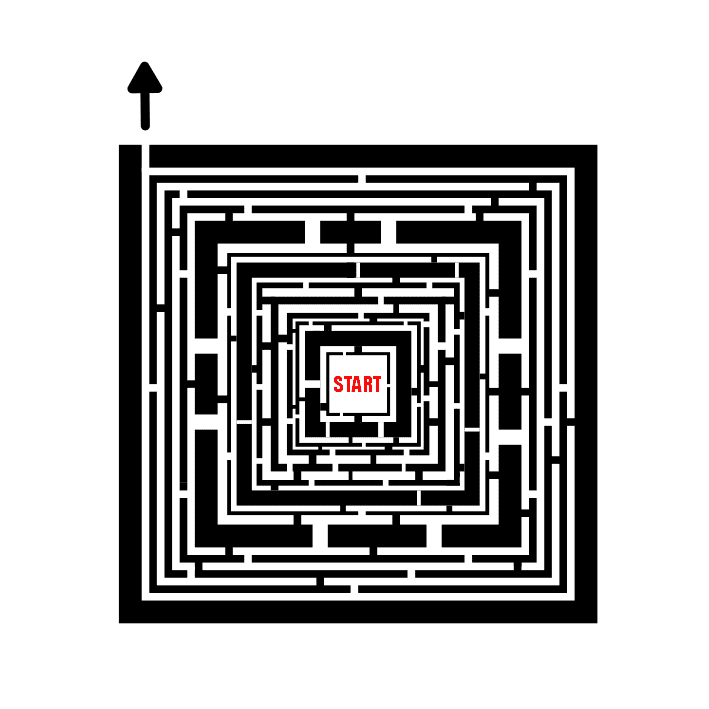
Ohio state maze

Start at the border of the maze

escape maze

Internal start

dual emtrance maze

Undefined Start - You choose the start and the goal

arrow maze

Undefined Start - Start / Goal Arrow Maze - You determine which is which !!

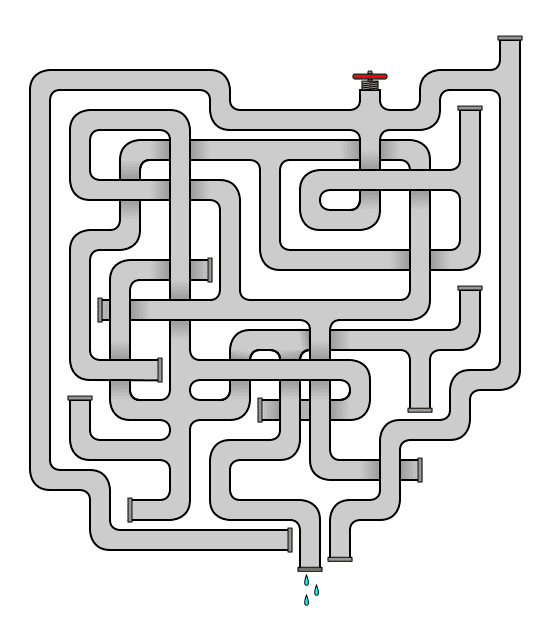
Ohio state shaped pipe maze

Specialty Start - Faucet Start

Line leads spider maze

Multiple starting options - Line Leads Maze

  • What type of Paths/Walls it Uses

I believe there are 5 categories of how you might construct pathways and walls:

  1. Walled Pathway

  2. Gridded Specialty

  3. Grid Walls

  4. On line Pathway

  5. Specialty pathways

The paths are integral in the construction of any maze. The thing about paths is they are created usually by drawing walls. They really don’t exist without the other. The maze you are picturing in your head is probably the most popular pathway, the walled path, typically a line. Those lines create walls that you travel between. The next most popular pathway is the gridded specialty structure. It encompasses all of the maze types that use box grids to house the maze. Think of Arrow, Slide Arrow, Number, Letter and Puzzle Mazes. Each uses a grid pattern to house specialty symbols/items that dictate how you may move. Finally, the standard grid wall structure. A regular grid wall structure allows movement in a more typical way, through cuts in the walls to create a pathway. The last common pathway is the on line pathway. In this type you travel on the line, so that there are no walls. This exists for On-Line, Line Leads, Conditional Path, and Directional Mazes. The last group are a variety of specialty paths each unique to 1 or 2 maze types. 2 specialty paths share the common design of weaving, the Pipe maze and the Weaving maze., each which allow the solver to move over and under the other pathways! Additional specialty mazes include Pattern Mazes which will vary in their pathways based on the pattern you are mazing. Object Mazes use objects for walls, creating unique pathways. Draw and Cut mazes are similar in that the pathways reflect whatever is is you have drawn. For additional reading, I did a blog post about the 12 most common pathway types: Maze Pathway options.

Let’s look at some examples for each:

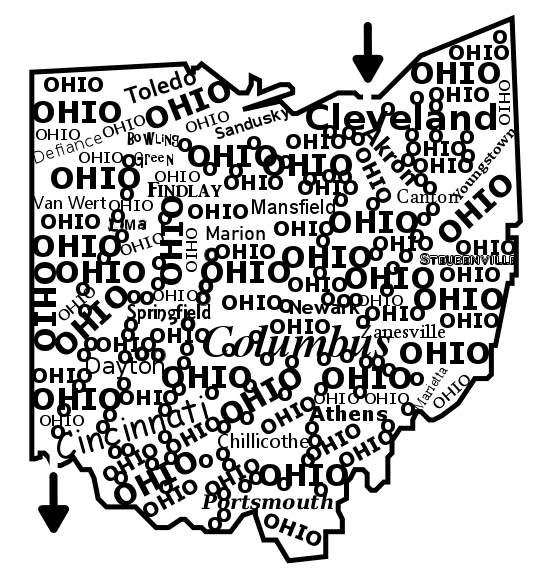
Ohio maze

Walled Path

Puzzle Maze

Gridded Specialty - Puzzle Maze

Grid maze

Grid Path

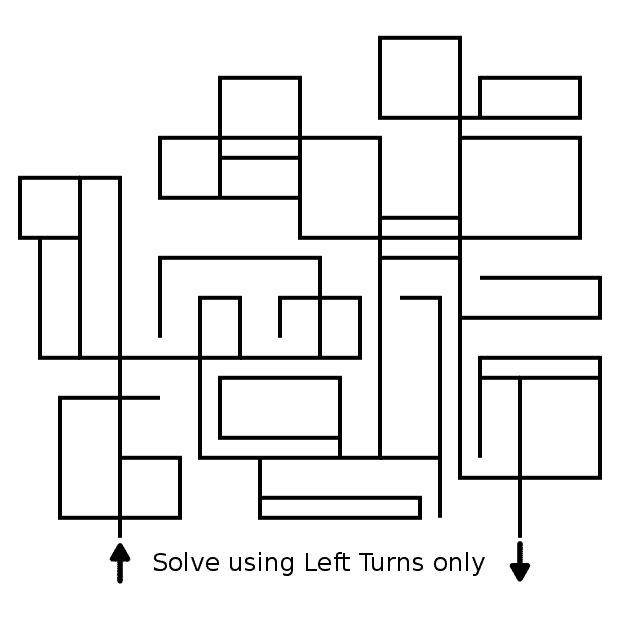
Left Turn Only  maze

On Line Path

Pipes Ohio maze

Specialty Path - Weaving

Smile maze

Specialty Path - Weaving

Ohio names maze

Specialty Pathway - Objects (words in this case)

Square cut maze

Specialty Pathway - Draw and Cut

  • Does the Maze Have an Outline

As far as constructions go this is pretty simple because it is a Yes/No answer. Bordered mazes are the standard with defined outer edges common to determine the shape and size of the solvable maze. However, some mazes have less structure. Think about a Weaving Maze and a Pipe Maze. Neither has a defined border as you travel in pathways which create the structure of the maze. Non-bordered mazes are also easy to see with Line Leads Mazes, where the squiggly lines make the structure chaotic. Some Mazes have defined structures, but no real border like a Math maze. You could make a math maze in a defined bordered structure, but it is not pertinent to solving.

ohio maze

Yes -it has a border

Ohio pipe maze

No border

Left Turn Only  Maze

No border

Escape maze

Yes it has a border

  • Are there any Conditions you need to follow to solve it

Most mazes are rather straightforward in how they are solved, but there can be a LOT of variety in the conditions. So the answer is either Yes or No, but the Yes has a huge amount of different conditions ! Let’s start with a standard maze which has No conditions to solving. The solver enters the maze, travels in it, then exits at the goal. That is the normal flow of most mazes. But sometimes there are conditions. A common clue is that if the maze comes with directions it is most likely conditional. Let’s look at a few: Solve the Puzzle to Move can describe many conditional mazes generally like a Block Move Maze. A Block Move Maze requires you to find a path between the start and goal by finding and moving the appropriate blocks to create a path. There are rules on how those blocks may move. A Puzzle Maze requires you to solve the puzzle to move correctly. A Number Maze requires you to choose the correct given numbers to move correctly. Same for a Letter Maze. A Conditional Path maze is by definition part of this as the puzzle you need to solve determines your movement. Likewise a Directional Maze (like a left turn only maze). Next is the Non Repeating Path condition. This is commonly used in a Find Items Maze and a Go & Return Maze. Each or these maze constructions require you to visit places in the maze before exiting, but the path you take may not backtrack from the way you came. Finally there is the Allowable Movement maze types. For me this includes Arrow Mazes and Slide Arrow mazes where movement thru the maze includes options on WHERE to go, but not HOW you may move. For more examples check out my blog on the 11 most common conditions: Conditional Pathway options

Let’s look at some examples:

Puzzle Maze

Solve the Puzzle to Move

Left Turn Only  Maze

Solve the Puzzle to Move - Left Turn Only

Go and Return Ohio maze

Non-repeating Path

Arrow Maze

Allowable Movement - Arrow Maze

  • What is the purpose/goal of the maze

I believe there are 5 categories for the purpose of a maze

  1. Reach the Goal

  2. Escape the Maze

  3. Solve a Puzzle

  4. Specialty purposes

  5. Unsolvable mazes

This answers the question - What are you trying to do in order to solve the maze ? The most basic purpose of a maze is also the most common, to reach the goal. While you may think this is the case for all mazes, here are a few other options: Escape the maze - this is of course used for the Escape Maze, where you start inside the maze and your goal is to escape the outer border. There are also instances where the purpose of the maze is to Solve a Puzzle. This includes a Hidden Trail Message Maze where the act of solving the maze creates a message for the solver. It also includes the Find Items Maze type where reaching the goal is only half of correctly solving the maze, you must also find certain items along the way ! Finally there are some Specialty purposes that only apply to 1 or 2 maze types per instance. Like the Math Maze whose purpose isn’t really to reach the goal or solve the puzzle, but you do each in order to learn mathematics ! And there is the specialty maze that should be used only for April Fool’s Day, the Unsolvable Maze. Or you made a mistake when you designed it, oops.

Ohio maze

Reach the Goal

Escape Maze

Escape the Maze

Hidden Trail Maze

Solve a Puzzle - Hidden Message Trail Maze

Ohio maze

Solve a Puzzle - Find items, then exit

Math Maze

Specialty - Math Maze

Hidden message maze

Specialty - Hidden Message Maze

So these are my 5 Maze Design Decisions that Differentiate Maze Constructions with examples. I have taken the time to summarize each of the 40 maze constructions based on these 5 criteria. Check out the chart below. Yellow highlights are on things that are not typical for a particular category.

Maze Construction comparison chart

Of the 40 mazes construction types, if we select the most common type for each of the 5 most common characteristics how many maze types are included ? So this would mean a maze that:

  1. Starts at the border

  2. Has walled pathways

  3. Has an outline

  4. Is NOT conditional to solve

  5. And whose purpose is simply to reach the goal

That leaves us with 12 closely related mazes out of 40. And, if we wanted to add a 6th differentiator, the differences between these 12 mazes are generally HOW the walls/pathways are drawn. Happy maze designing !

You may also like:

I did a 3 part blog series on maze constructions if you want to design your own type of maze.

Part 1 - Starting and Ending a Maze - Speaks to the 9 most popular ways to start and stop a maze

Part 2 - Maze Path options - Explores the 12 different pathway options for a maze

Part 3 - Conditional Path options - Speaks to 11 different conditional options to add to a maze to make it more enjoyable

Twisty Little Paths: Creating New Types of Experimental Mazes

I spent an entire month making Experimental Mazes were I came up with 11 different types of mazes. Each type had at least one daily maze posted on the site and some of these experiments had up to 5 different versions. Today I want to pull each of these new maze creations together and review them, see how I did, what worked and get some feedback from you.

Part 1 - Perspective Arrow Maze

This idea is pretty simple: Arrow Maze + a change in perspective. I did 5 different versions and below is my favorite example. A typical Arrow Maze is flat and I thought adding some perspective would be interesting. I enjoyed making this and getting the maze aligned as I made it in sections.

Perspective Arrow Maze

Perspective Arrow Maze

Part 2 - Multi Arrow Maze

This idea is connected Arrow Mazes. Day 1 is Arrow Maze 1 you solve normally. Day 2 adds Maze 2 (the upper left corner). The solver starts in the same place, but tries to reach the Day 2 Goal in Maze 2. This continues each day. Day 3 adds Maze 3 and a new GOAL. By day 5 you have 5 Arrow Mazes combined into one. Can you solve each maze in order ? Good Luck. To clarify, landing on a corner of the center arrow maze opens up the new maze section to you.

Multi connected Arrow Maze

Multi Arrow Maze

Part 3 - Color Grid and Grid Maze Combo

Another combination maze, this one featuring a color grid maze and a grid maze. Since the Color Grid is already “gridded” this made it easy to create a 2-in-1 maze. Solve the 2 mazes in any order. In this case the start and goal is the same for each maze type.

Color Grid and Grid Maze Combo

Color Grid and Grid Maze Combo

Part 4 - Folded Grid Maze

A Grid Maze that has the appearance of being a folded piece of paper based on changing the perspectives on a few sections. I did 2 versions. Easy to make. Looks more interesting than a regular grid maze, but is nothing earth shattering.

Folded Grid Maze

Folded Grid Maze

Part 5 - Layered Grid Maze

A Grid Maze that uses multiple layers to give the maze a more interesting look. Honestly, this is not very experimental in hindsight. It looks marginally more interesting, but at the end of the day is still just a grid maze.

Layered Grid Maze

Layered Grid Maze

Part 6 - Arrow and Grid Maze Combo

Another 2-in-1 maze experiment. This one combines the Arrow and Grid Mazes. I made it to be solved Arrow Maze first, then Grid Maze after, returning to the original start, but you can technically solve in either order. I like the idea of the start of one is the goal of the other. I did 4 different mazes of this type.

Arrow Maze Grid Maze Combo

Arrow Maze Grid Maze Combo

Part 7 - The Sectional Maze

A Sectional Maze uses lightly connected sections and weaving pathways to travel throughout the maze. Nothing too crazy, but a new type of maze for me. Maybe the newest portion is the one way pathways between sections. I feel like this is a small version of something much larger and more interesting.

The Sectional Maze

Sectional Maze

Part 8 - Standard Perspective Maze

A standard maze where I have played with the perspective. I think this is the least appealing maze I made playing with perspective. Boring in this example and possibly boring in most examples. When I originally thought of it I was thinking it would look like a folded piece of paper. This particular example is also a Kids maze.

Standard Perspective Maze

Standard Perspective Maze

Part 9 - Stacked Grid Maze

A Grid Maze (blue) inside a grid maze (black). Day 1 included only the black walls, while Day 2 uses both black and blue to create the walls. I stopped after 2 days as the solution stays generally the same on day 2 in this version.

Stacked Grid Maze

Stacked Grid Maze

Part 10 - Pipes and Arrow Maze Combo

Another 2-in-1 maze that combines Pipe Mazes and Arrow Mazes. These can be solved in any order. I looks a bit odd but these are 2 of my favorite maze types. I will say as a designer this maze type takes a long time to make. If I could make this faster I would make more.

Pipes and Arrow Maze Combo

Pipes and Arrow Maze Combo

Part 11 - Stacked Standard Maze

5 Mazes in 1. Each Day for 5 days I added a new layer to solve. Each smaller arrow adds a new layer of walls to impede you. So the maze starts with black walls only. The next maze on day 2 uses black and grey walls. Then + Blue, + Red, and finally + Green. I thought this was a fun idea. But the actual execution is tough on the eyes and not as enjoyable to solve as I thought. I wonder if wider spacing for all maze pathways would improve it.

Stacked Standard Maze

Stacked standard maze

The odd sizes mean I did not make these mazes into a traditional free downloadable book, but I did gather them into a 31 page booklet. It is not recommended for printing. The download is 392Kb and is best used on screen.

Are there some mazes you like that should be continued and explored ? Send me a request.