Book Review: Esoteric Mysteries of the Underworld

Esoteric Mysteries of the Underworld: The Power and Meaning of Subterranean Sacred Spaces (2020) - 320 pages. AMZN. by Jean-Pierre Bayard

Esoteric Mysteries of the Underworld: The Power and Meaning of Subterranean Sacred Spaces (2020)

Esoteric Mysteries of the Underworld

My focus for this book was Chapter 2, titled The Labyrinth: A Symbol of the Underworld. After the background and overview of Chapter 1 I was less interested in the Telluric Currents or Denizens in the Underworld sections that followed. But if you like to read about ley lines, dwarfs, gnomes and the hollow earth - it is all covered !

What you can expect in this book:

  • Labyrinths are often seen as symbols of the underworld. This is because they are typically maze-like structures with a single path leading to the center. The journey through a labyrinth can be seen as a symbolic journey into the underworld, where the individual confronts their shadow self and undergoes a process of transformation.

  • Labyrinths are also seen as symbols of the journey of the soul. This is because the path through a labyrinth is often winding and challenging, just like the journey of life. The journey through a labyrinth can be seen as a metaphor for the spiritual journey, where the individual faces challenges and obstacles on their way to self-realization.

  • Labyrinths are also seen as symbols of initiation. This is because the journey through a labyrinth is often seen as a rite of passage, where the individual is transformed and reborn. The labyrinth can be seen as a symbol of the process of initiation, where the individual enters a new stage of life and takes on new responsibilities.

What this book does best: This is very different than most books because of the perspective it is coming from since everything is seen through the lenses of the underworld !

Book Review: Follow This Thread: A Maze Book to Get Lost In

Follow This Thread: A Maze Book to Get Lost In (2019) - 240 pages. AMZN. by Henry Eliot (Author)

Follow This Thread: A Maze Book to Get Lost In (2019)

Follow This Thread: A Maze Book to Get Lost In

The first thing you are going to notice about this book is the unique format. The text of the book follows red thread through the pages. I don’t think there is any grey with this - you’ll hate it or love it.

What you can expect in this book:

  • The book begins with a discussion of the history of mazes, from their earliest origins in ancient Egypt and Greece to their modern-day use in everything from video games to corporate logos.

  • It then explores the psychological and spiritual significance of mazes, arguing that they can be seen as symbols of the journey of life, the process of self-discovery, and the search for meaning.

  • The book also includes a number of personal essays by Eliot, in which he recounts his own experiences with mazes, including his childhood visits to the Hampton Court Maze, his attempts to solve the Chartres Labyrinth, and his participation in a modern-day mystery school that uses mazes as a tool for spiritual development.

What this book does best: The illustrations and format of the book are wonderful. If you click to the Amazon link above you catch watch a short video and see the book layout. Very cool !

Book Review: Mazes for Programmers by Jamis Buck

Mazes for Programmers: Code Your Own Twisty Little Passages (2015) - 288 pages. AMZN. by Jamis Buck (Author)

Mazes for Programmers: Code Your Own Twisty Little Passages (2015)

Mazes for Programmers: Code Your Own Twisty Little Passages

The book is a comprehensive guide to generating mazes using a variety of algorithms. It covers both the theory and practice of maze generation, and includes working implementations in the Ruby programming language.

What you can expect in this book: The book is broken into 3 parts:

  • Part 1: Basic Maze Generation introduces six different maze generation algorithms, including the Binary Tree algorithm, the Eller's algorithm, and the Hunt and Kill algorithm. It also covers how to draw mazes and how to solve them using Dijkstra's algorithm.

  • Part 2: Advanced Maze Generation shows how to constrain mazes to different shapes and outlines, how to cull dead-ends, and how to make mazes weave over and under each other. It also covers how to generate mazes in multiple dimensions and on curved surfaces.

  • Part 3: Appendices includes additional information on maze generation, such as a list of maze generation algorithms, a discussion of maze properties, and a collection of maze puzzles.

What this book does best: The book does a good job of explaining the trade-offs between the different maze generation algorithms. This is important information for anyone who wants to choose the right algorithm for a particular application.

Exploring Different Ways to Solve a Maze

So you want to solve a maze and could use some extra help. Or, more likely you are writing a computer program and want to know what options you have to solve a maze. I will take you through 8 popular maze solving methods and then discuss some of the the other most common everyday ways of solving mazes people use and give you some cheat codes. Here is what you can expect:

8 MAZE SOLVING METHODS

  • 4 METHODS FOR PHYSICAL MAZES SOLVED FROM THE INSIDE

  • 4 METHODS FOR MAZES VIEWED FROM ABOVE

5 COMMON MAZE SOLVING OPTIONS

2 CHEAT CODES TO SOLVE MAZES

2 INTERESTING MAZE SOLUTIONS

8 MAZE SOLVING METHODS

Let’s start with 4 methods used for physical mazes, like a hedge or corn maze, where you do not know what the maze looks like, i.e. you are a traveler in a maze looking to find the exit or goal.

  • Random Mouse Method - Very basic way to solve a maze and probably the way you typically do it. Starting walking, and randomly pick a direction at each intersection you reach. Nothing fancy, and not efficient, but works eventually. Also works for regular mazes you see from above - and probably how you solve most puzzle mazes.

  • Wall Follower Method - Well known way to solve a maze where you follow a wall consistently through a maze until you solve it. It can be a left handed or a right handed method, but once you choose your side you must stick with it ! To use this the maze must be simply connected, meaning it has no loops and all walls are attached to the outer walls of the maze.

  • Pledge Algorithm Method - A wall following method that can deal with disjointed walls. It involves counting turns you make (clockwise turn is positive, counter-clockwise turn is negative) and making decisions based on getting the number back to zero. Here are rules to follow to use it in practice:

    • Start at the entrance of the maze.

    • Move forward until a wall is encountered.

    • Follow the wall on the right-hand side until you reach the exit.

    • If you encounter a disjoint wall, you should turn left and continue following the wall on its right-hand side. How do you know you have a disjointed wall ? You arrive back at the same spot in a disjointed wall (a loop).

    • If you return to the starting point without finding the exit, turn around and follow the wall on its left-hand side until it reaches a new path. Then, it should follow the wall on its right-hand side again.

    • Repeat steps 3-5 until you reach the exit.

  • Trémaux's Algorithm - Uses a set of rules to solve a maze:

    • If you visit a junction with new paths, pick one at random.

    • Cross it out as you explore.

    • If you reach a dead end, retrace your steps to the last junction with unexplored paths and choose another path.

    • If you reach a junction with all paths already explored, retrace your steps to the last junction with unexplored paths and choose another path.

The following 4 methods of solving a maze are useful for typical puzzle mazes where you can see the complete maze from above:

  • Reverse Solve (Dead-end filling) - In this method you start at a known dead end and color in the pathway until you reach a junction. Eventually this process leads to a maze completely filled in expect for the correct pathway ! I like to use this for hidden message mazes !

  • Recursive algorithm - Math, coding. That is where this algorithm comes in. It uses X and Y values to check each spot inside a maze and determine if the space has been visited yet or not. It marks incorrect solutions as it goes and if it finds the correct pathway it marks in the X/Y values (pathway) of how it got there.

  • Maze-routing algorithm - Commonly used in chip design but can be used to solve a maze also. It is not something a person would use unless they coded it into a program. It works by finding the distant between any 2 points in the maze, blah, blah, blah, look you solved the maze !

  • Shortest Path Algorithms - A collection of many algorithms which all attempt to do the same thing - find the shortest path between 2 points - like let’s say the start and the goal ! While the details of this set of algorithms may not be for the average person to use to solve a maze, be glad it is used whenever you need directions between 2 points (Google Maps !, etc.)

Now let’s look more specifically at real world examples and the methods most people actually use for puzzle mazes. What method do you use to solve drawn mazes ?

5 COMMON MAZE SOLVING OPTIONS

  • With a writing utensil - probably the most common way to solve a drawn maze. You have a maze printed out or in a book in front of you and you grab a pen or pencil and solve using it. Makes the maze a one time use unless you have an eraser that does a good job and doesn’t harm the paper too much

  • With your finger - you use your finger as a guide to work your way through the maze and solve it. This method allows multiple people to solve the same maze

  • With your eyes - my personal most common maze solving method. Works for most maze types, although you need to add in a more comprehensive method for any spiral maze.

  • Reverse fill with a writing utensil - a method I used to use because I liked the way it looked. You use a pen / pencil and start at dead ends, filling each in until you reach a new branch. Eventually this leaves only the correct path NOT filled in, creating a reverse solve !

  • Of course online puzzles and mazes will use a combination of arrow keys or your mouse to solve a maze.

2 CHEAT CODES TO SOLVE MAZES

  • Solve it in Reverse - if a maze is giving you trouble, try solving it in reverse. Most mazes are mush easier this way since the maker of the maze likely designed it specifically to be solved in the Start to Goal direction. Of course some maze designers take this method into account and design difficulty in both directions ! These are called Dual entrance/exit mazes and you can learn how to make on and see examples of them here.

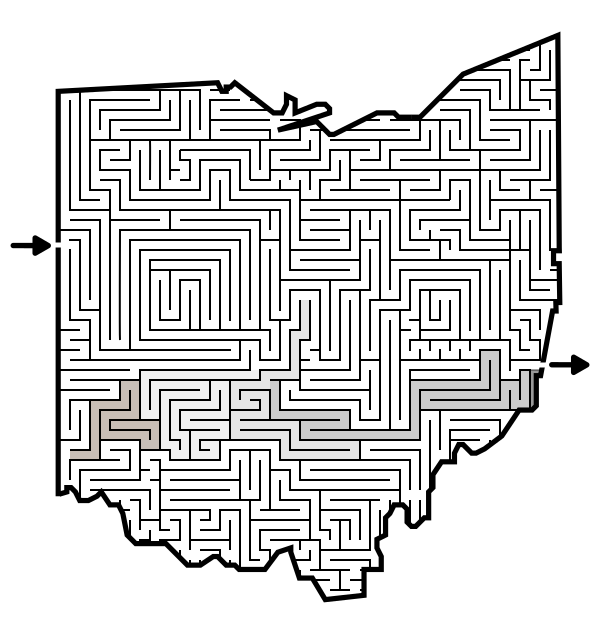
  • Middle Marking - This is what I call it. Before starting the maze pick a central spot in the maze and follow it until you reach a dead end. Color out that dead end. Choose the spot directly to the right of that spot and do the same. Repeat. The goal is to block out one side of the maze as unpassable by cutting it in half. Can also be done north/south. Here is an example where I repeated this 5 times (using 5 different shades of grey) and cut off the bottom half of the maze as a possibility. If I wanted to continue using this method I would start at the northern border and work my way down until I found the passable pathway !
Ohio Maze with shaded dead ends shown

Those are 15 ways to solve a maze. Now let’s look at some fun things to think about as a maze designer !


INTERESTING MAZE SOLUTIONS

If you like to design mazes I want to show you 2 fun ways to create maze solutions. Each can be used to add some fun to solving mazes.

Hidden Message Mazes - A maze that looks normal, but the solution has a message for the solver.

Here are 2 blog posts where I show you how to make your own (2 different types):

How to Make A Hidden Message Maze

How to Make a Hidden Message Trail Maze

And of course I made some templates (4 different) to help you make “mazed” letters if you are interested in creating your own mazes:

Hidden Message Maze Letter Design templates

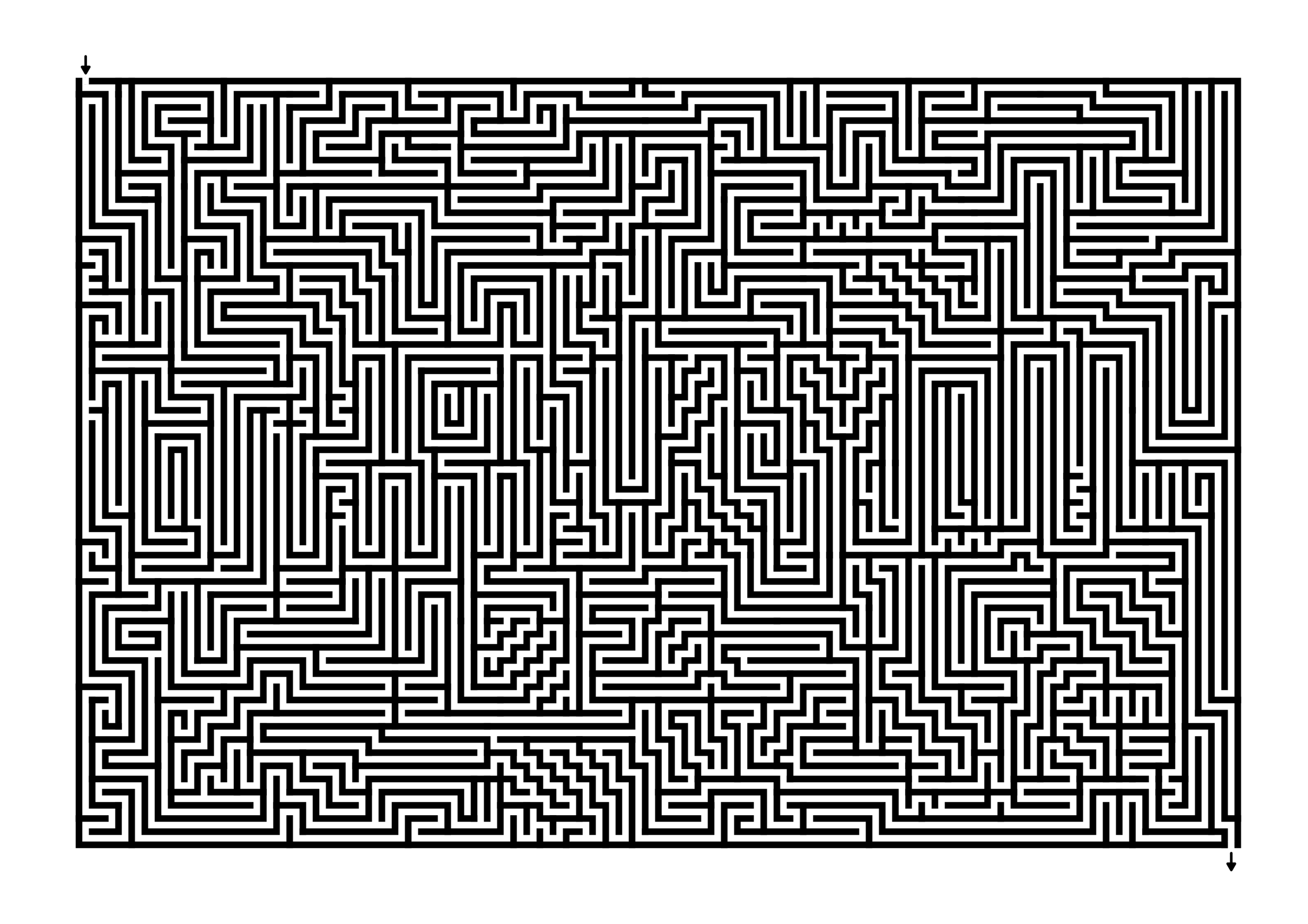
Here is an example of a hidden message maze. See if you can figure out what it says before scrolling down:

hidden message maze
Scroll Down for answer
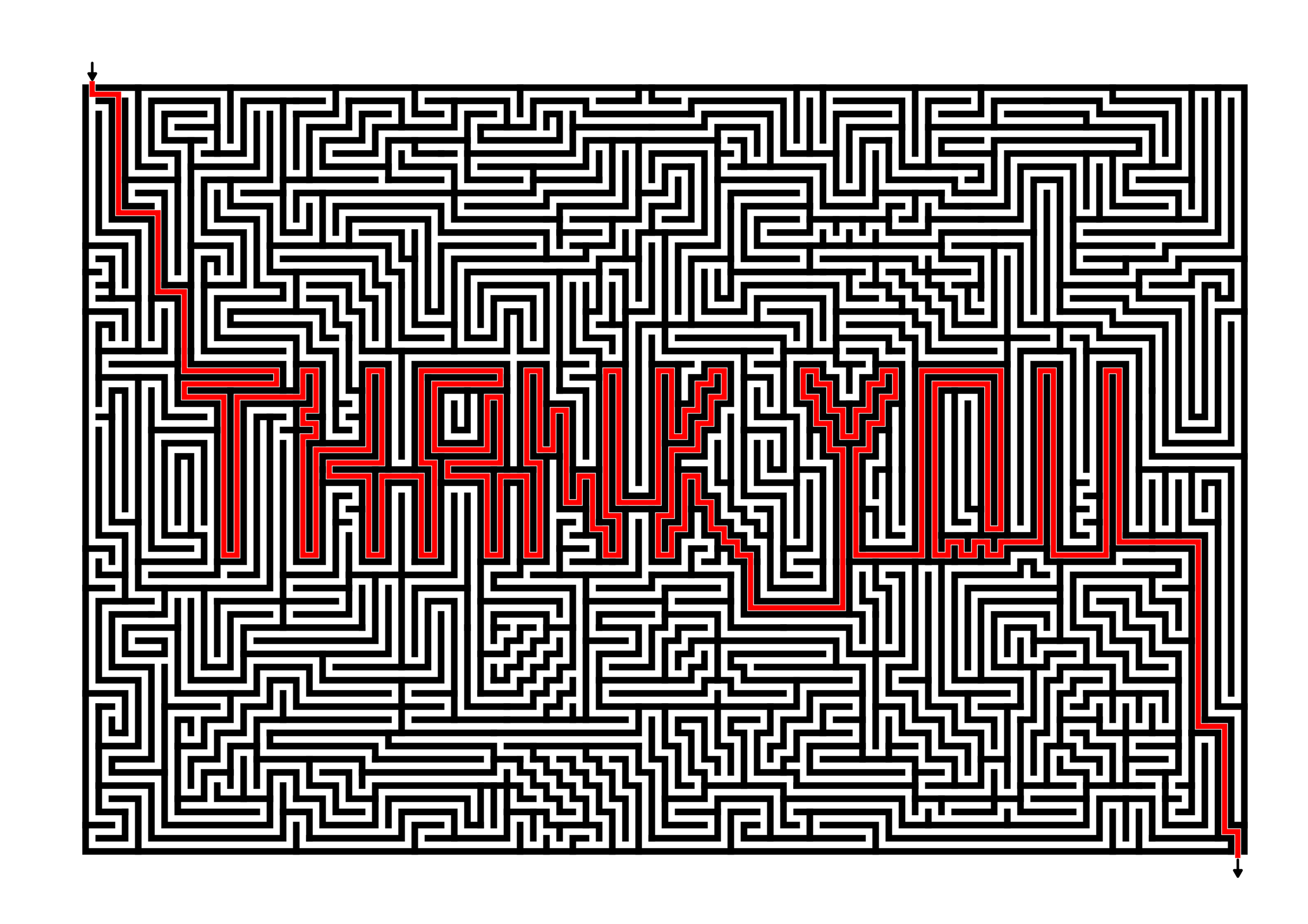
hidden message maze - thank you solved

Did you get it ? If you enjoy that challenge, check out Hidden Message Challenge - Part 1, or if you want to try some in Spanish: Desafío Laberinto de mensajes ocultos. You can also do this in regular mazes. like my maze of Monte Alban in Mexico.

Creative Maze Solutions

I find it hard to define this even though I have a great example of it.

My maze of the Museo Soumaya. Well, because I gave it a creative solution and that solution is even more hidden than a typical maze I make. I dare say it is completely hidden ! Let’s look at the maze. Do you see the answer ? You don’t.

Museo Soumaya MAZE

To download the maze and solve it yourself check out the Museo Soumaya page here. Or just watch the solution on my YouTube channel below. When do you figure out the surprise ?

Happy