Maze Comic Book Reviews - Theseus And The Minotaur

If you are a fan of mazes and the mythology behind them you know the story of Theseus and the Minotaur. Most people know the core portion of the story where Theseus meets the Minotaur in the middle of the maze. Today I will review 4 different comic adaptions of the story, show you some illustrations and hopefully help you pick the comic you want to read most. Or, you know, read them all.

Theseus And The Minotaur: A Graphic Retelling (2015)

from Capstone, 32 Pages

by Matt Chandler ; illustrated by Estudio Haus

Theseus And The Minotaur: A Graphic Retelling (2015) cover

The first comic is a quick read (32 pages) about the entire story of Theseus.

The comic is broken into five chapters and takes you through the Greek myth of Theseus from birth, to growing up, to his quest-like journey and finally his meeting with the Minotaur and return home. All of this happens in 32 pages. The illustrations are good.

Chapter 4 is my favorite chapter, called The Labyrinth, and is the showdown between Theseus and the minotaur in the labyrinth (which is actually a maze as you can see in the comic panel below).
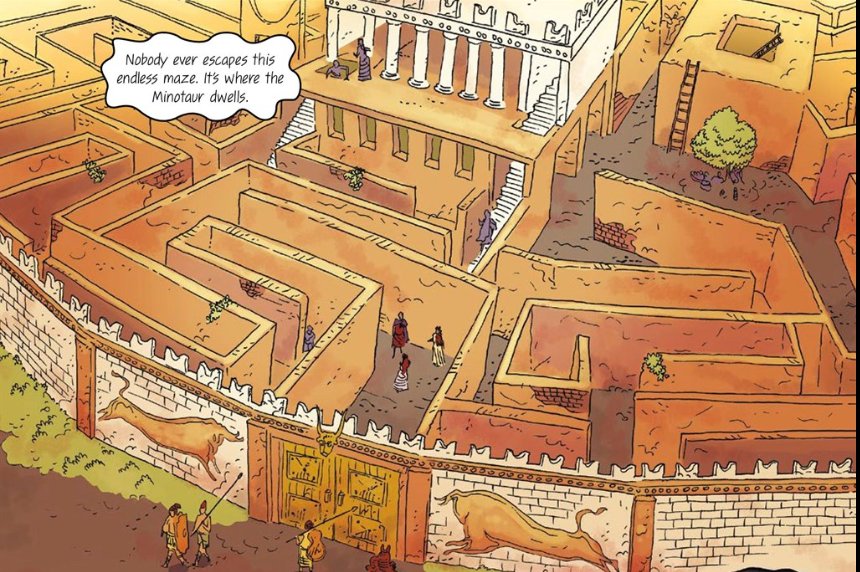
Theseus And The Minotaur: A Graphic Retelling (2015) panel

And of course part of the story is the fact that the maze is very challenging and has never been exited before. This Greek myth originally was written by Apollodorus in his book The Library of Greek Mythology. Part of me loves that he has his own Amazon author page, and part of me hates it. Anyway, this story survives from this book.
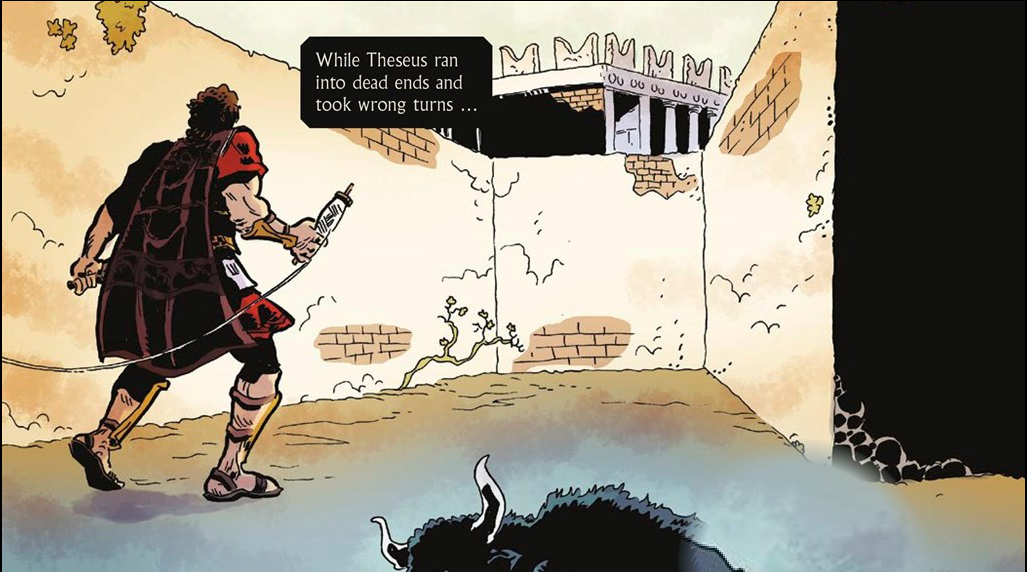
Theseus And The Minotaur: A Graphic Retelling (2015) dead end panel

Comic strip from the book

This is a good telling of the Greek Myth, and a fast read with nice illustrations. 7.8/10

Theseus And The Minotaur (2009) AMZN

from Capstone, 72 Pages

by Nel Yomtov ; illustrated by Tod Smith

Theseus And The Minotaur (2009) comic cover

The comic is broken into six chapters and takes you through the Greek myth of Theseus. If you compare to the 32 page version above, you get a longer and more detailed story. An event that was 5 separate panels in the first comic is now 10 panels, etc. The additional space also makes the quest portion of the book much longer and I think that helps tell the story.

Chapter 5 is titled The Labyrinth and this is the portion of the story I am most interested in. One thing that disappointed me about the book was there was no large illustration of the labyrinth, just the slender picture below.

Theseus And The Minotaur (2009) maze panel

One thing this comic does well is illustrate the battle between Theseus and the Minotaur and expands that to multiple pages. Here is the initial meeting in the labyrinth.
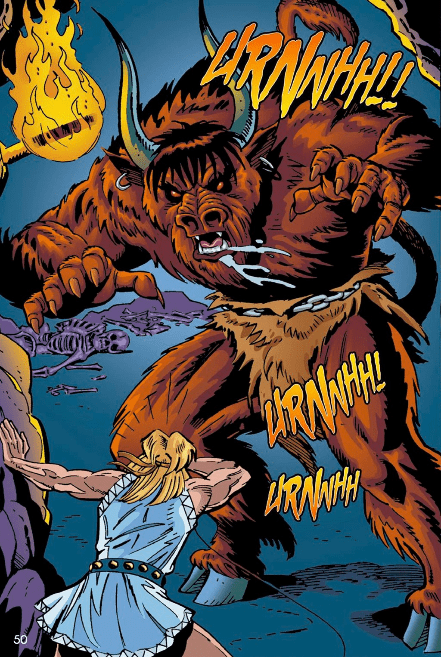
Theseus And The Minotaur (2009) - Minotaur panel

Overall, if you want a bit more to the story, read this version.

This is a nice telling of the Greek Myth, and has good illustrations. 7.2/10

Kill The Minotaur (2018) AMZN

from Image Comics, 184 Pages

by Chris Pasetto, Christian Cantamessa ; illustrated by Lukas Ketner
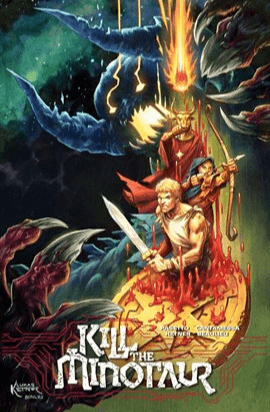
Kill The Minotaur (2018) cover

This version has the most recent publication date (2018) and is from Image Comics. It is also our longest version of the story at 184 pages.
Of the 4 different comics I review on this topic, this has the most unique story. The other three basically told the same story of Theseus from birth, growing up, a journey, meeting the king, the minotaur in the labyrinth, and his return. This is really focused on the Minotaur and the labyrinth, and I would say 80+ percent of the story takes place in there. This is also the only book to feature curse words and adult situations (this comic is not for kids IMO).

This version also tells a slightly different story than the previous versions, although with the same basic characters and themes. We also get a Minotaur that is deformed and has magical properties, roaming a labyrinth that also has some unique characteristics. I enjoy this version of the story because it takes place in the setting I am interested in, the labyrinth.

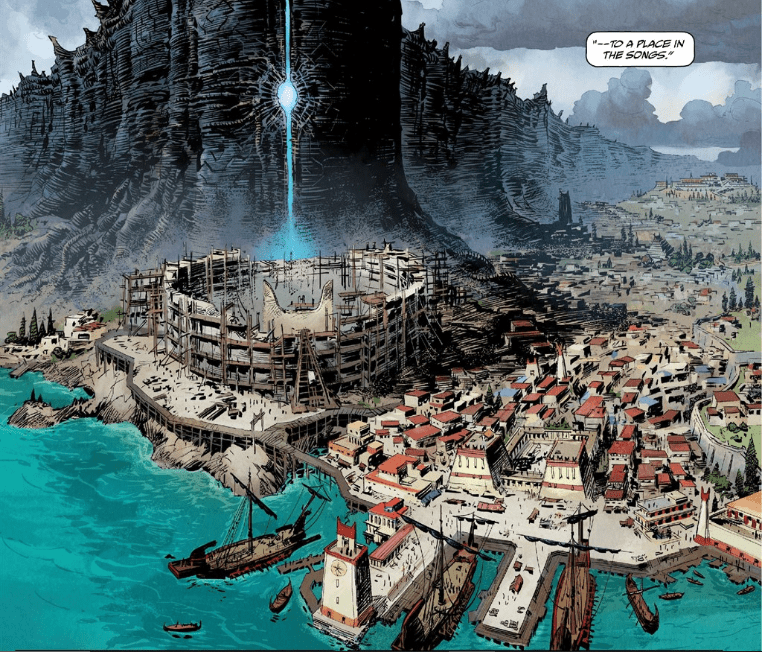
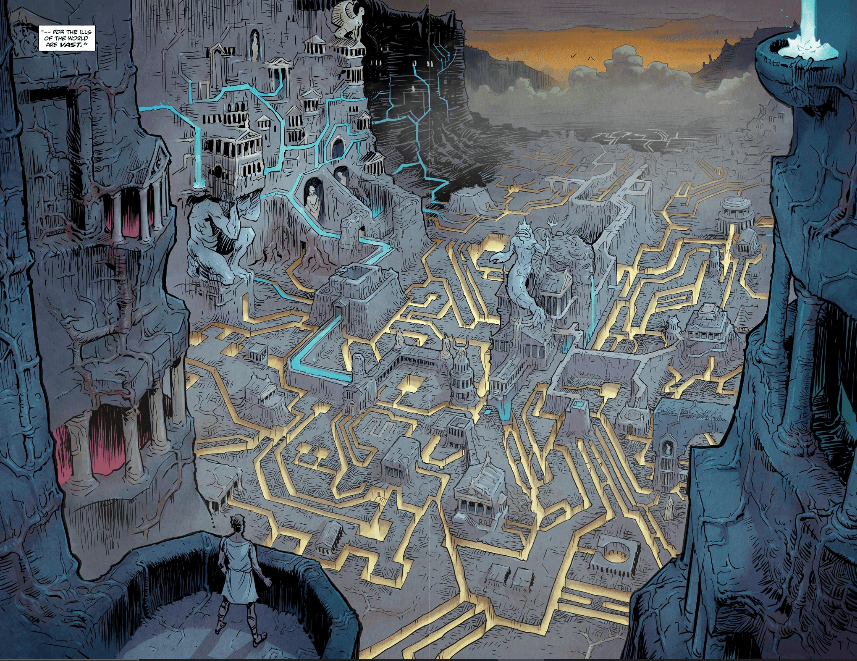
From an illustration standpoint the longer length also means more larger landscape artwork. Check out this large format illustration of Crete and this drawing of Theseus overlooking a portion of the labyrinth.
Different than the other versions, so worth it’s own read even if you know the story, you do not know this one ! 7.5/10.

Theseus Battling The Minotaur (2007) AMZN

from Lerner Publishing Group, 48 Pages

by Jeff Limke ; illustrated by John McCrea

Theseus Battling The Minotaur (2007) comic cover

Like our previous review, the comic is broken into six chapters and takes you through the Greek myth of Theseus. The extra few pages mean an expansion of the story from previous versions. We even get introduced to a few more characters that didn’t fit into the shorter versions.

Chapter 5 is titled Into The Labyrinth and if there is one thing this is missing is an illustration of the actual labyrinth. But there is a reason for this - in this version the labyrinth is underground ! So while I could show you a panel of Theseus in the labyrinth, it will just be a picture of him in a dark cave. Not very exciting. What IS exciting is the battle as shown by the panel below.
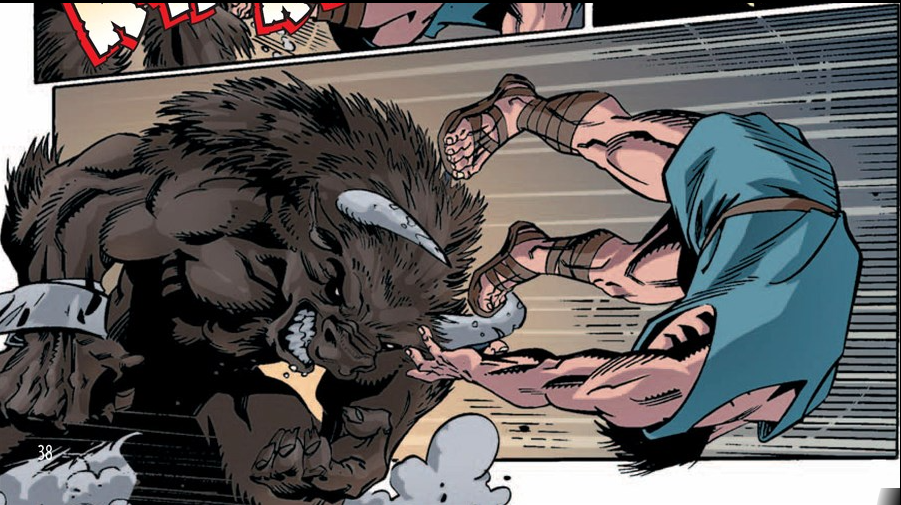
Theseus Battling The Minotaur (2007) - Minotaur attack panel

This is a nice version of the story, I just wish we could have seen the labyrinth. 7.0/10

So there you have the 4 different books. All are similarly rated by me it just depends how much time you want with the story with 32, 48, 72 and 184 page options available. I liked the short and long versions best, but none is a bad read.

Other blog posts you might like:

Jim Henson’s Labyrinth Comic Reviews

Neverwhere Comic Review by Neil Gaiman

A Review of 4 Comic Books that Feature Mazes and Labyrinths

I am back with another comic book review that involves either a maze or a labyrinth. Today I take you through 4 different stories, 2 that I highly recommend you check out. We get a warrior that can’t die, a creepy horror story, a secret society of magical families and a young adult fantasy book series that was made into a few movies.

Wrath Of The Eternal Warrior Vol. 2: Labyrinth (issues 5-10) AMZN

from Valiant Entertainment, 176 Pages

by Robert Venditti ; illustrated by Raul Allen, Juan JosΓ© Ryp

Wrath of the Eternal Warrior Vol 2 Labyrinth

This comic has a body count that is high and very bloody. Our main character is a warrior who cannot die which means when he does battle others there is a lot of bloodshed and it is rarely his. If you are looking for some background on the story I suggest you start with Volume 1, but if you jump into Volume 2 to start you will be fine to follow along.

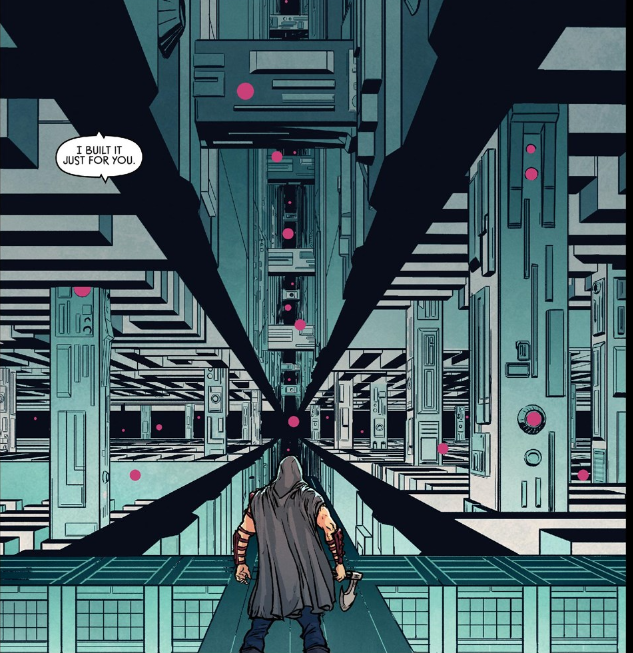
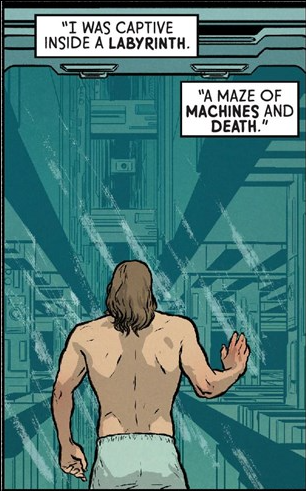
The comic begins with the left of the Eternal Warriors child, named Kalam while he is away doing battle and the subsequent quest to get him back. From there we begin the Labyrinth portion of the story. A mysterious man has captured the Eternal Warrior and is hoping to test him and figure out how he heals himself and can never die. The testing zone is an enormous high tech labyrinth (actually a maze) where he tests him with a variety of deaths/healing scenarios. That is the comic.

Of all the comics I have reviewed this has the most extensive artwork of mazes and labyrinths. Really great work by the illustrators. Here are a few of the covers/alt covers:

Wrath of the Eternal Warrior comic book cover collage

And here are some additional scenes of the labyrinth itself:

Wrath of the Eternal Warrior Labyrinth strip

Comic strip from the book

Wrath of the Eternal Warrior Maze view


If you like blood and destruction this is the comic for you. Excellent illustrations. I recommend. 8.5/10

Check out information on all 14 Eternal Warrior comics.

Ice Cream Man #30 (2022) AMZN

from Image Comics, Part of TPB: Ice Cream Man, Volume 8: Subjects & Objects 136 Pages

by W. Maxwell Prince (Author), Martin Morazzo (Artist), Chris O'Halloran (Artist)

Ice Cream Man #30 comic

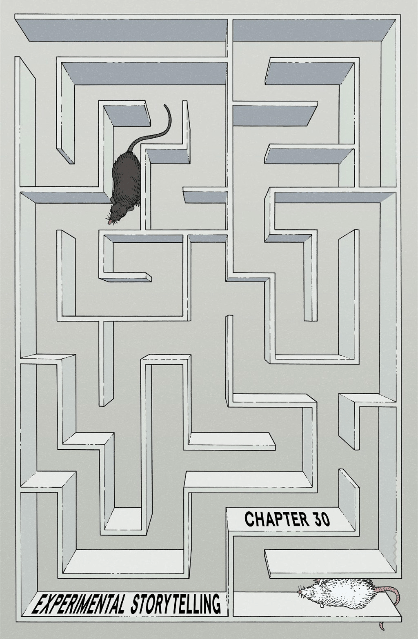
I have read each issue of Ice Cream Man. It’s a twisted horror comic that isn’t afraid to try interesting story formats. When I was reading the TPB and I flipped to Chapter 30 and saw the cover above I knew I was going to enjoy it ! Two mice making their way through a maze, one black and one white. What happens if they meet since they seem to be trying to get to the other side ( ones start is the others end ?). And you get the theme of the Chapter from the title, β€œExperimental Storytelling”.

This particular story is about a medical test. One patient gets a pill while the other gets a placebo, typical in a controlled experiment. Except this, like most stories in the series has a Twilight Zone experience to it. Everything is not what it seems. And more information would require a SPOLIER alert….which I am not giving. This is a solid sci-fi book and I recommend it. How does that make you feel ?

Read it. 8.7/10 !

Excellence #12 (2022) AMZN

from Image - Skybound, 31 Pages

by Brandon Thomas (Author), Khary Randolph (Cover Art, Artist), Emilio Lopez (Cover Art, Artist)

Excellence #12 comic cover

Excellence is a comic series that ran from May 2019 - Jan 2022 and had a total of 12 issues. I enjoyed the story, which is about a group of magical families and a secret society that controls them. It has a strong father / son relationship dynamic and deals with a new generation rebelling against an older one.

The final issue, features the cover you see above of a maze so I wanted to give you a review of the series. There is no real maze, per say in the issue, just the culmination of a mystery as the characters figure out what is going on. This is an isolated story that will not make sense solo, so read Volume 1 & Volume 2, a total of 304 pages which concludes with this arc.

Overall a good story. 6.8/10.

Percy Jackson And The Olympians: The Battle Of The Labyrinth (2018) AMZN

from Disney Book Group, 131 Pages

by Rick Riordan, Robert Venditti ; illustrated by Orpheus Collar, Antoine DodΓ©

Percy Jackson Labyrinth Comic book cover

This is the comic book version of the original book you may have read before. You could also be familiar with the 2 movies that were made in 2010 and 2013 but generally were poorly reviewed, ending the making of future movies.

This comic is all about a quest. If you like quest stories then you should enjoy this comic. From an overall story standpoint this is the 4th of 5 books that make up the Percy Jackson stories. For this reason, if you jump into this book you will not be familiar with the characters. I will say you can still enjoy the story, but you will not have the investment in the characters to really completely enjoy and understand what is happening. The bad guys won’t seem as bad, the good guys trials and tribulations will mean a little bit less.

Percy Jackson Labyrinth comic panel

Now about the quest. As you may have guessed, it takes place in a labyrinth hidden within the world. It you are not familiar with Percy Jackson, there are hidden worlds within our world that are used by the children of gods and half gods (like Camp Half Blood in Long Island , NY). One thing you will notice if you read this comic is that they interchangeably use the words maze and labyrinth (something I believe is incorrect). Anyway, our group led by Percy makes a journey, overcomes difficulties, meets interesting people along the way, engages in overcoming obstacles, and it all culminates in a final battle. I could have written the same sentence about any quest movie.

If you know the characters, you will enjoy this comic much more than just picking it up as a maze lover. I give it a 5.5/10.

While this was only book 4 of 5, if you are interested you can check out all 5 books:

Percy Jackson and the Olympians (5 books)

Other blog posts you might like:

The 12 Best Maze and Labyrinth Movies Of All Time

How to make over 40 types of maze

Maze Art Case Study - Bodiam Castle Maze Coloration & Improvement

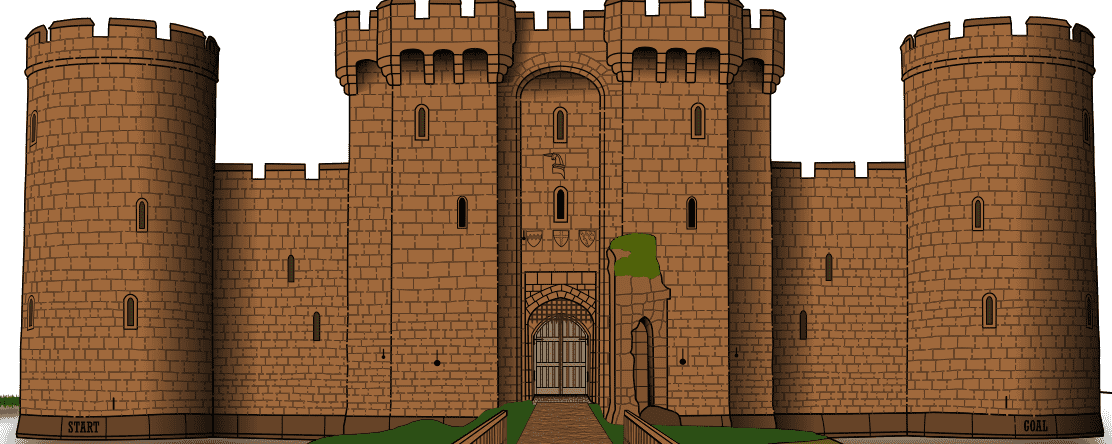
I wrote a blog post about improving existing maze art, Maze Art: Advanced Tips to Creating Your Own Masterpiece. I wanted to use my own writing to see if I could improve one of my own mazes. The maze in question is Maze of the Week #69 of Bodiam Castle in England. It is my second maze of a castle in England and this one I made only in black and white. When I was finished with the maze I didn’t really feel finished. I wanted to do more but was frustrated because the last section of the maze I worked on was a complicated. The parts that I could add would not have any bearing on the actual maze or maze solving so I moved to my next maze. Now I go back and try to improve the maze. Will work ?

Here are my 8 advanced tips for making maze art:

Tip #1 - Make lots of experimental mazes - DONE

Tip #2 - Get feedback - need to do !

Tip #3 - Famous landmarks/locations/objects get more interest - DONE.

Tip #4 - Leverage your unique skills - DONE , I make many building mazes !

Tip #5 - Don’t worry about β€œfitting” the maze into a particular size - DONE

Tip #6 - Slow down and take your time - I was rushing onto the next project…thus the case study !

Tip #7 - Add as many small details in the maze as possible ( & Consider adding shadows) - What I need to do.

Tip #8 - Take lots of detailed pictures of your subject - I do not live nearby but will search for as many details as I can find.

So 4 of the 8 tips apply to this maze. I will work my way through these and see how things go.

Tip #2 - Get feedback - I am going to send this to 2 friends to get some feedback and see what they say and include that in my changes.

Tip #6 - Slow down and take your time. I will be done when I complete the details I want to try and not before !

Tip #7 - Add as many small details in the maze as possible - This will be the core of what I do based off of additional pictures I find (Tip #8)

Here is my own evaluation of the small details that are missing in the current maze:

  • You can’t tell that there is a moat around the castle. I can try a few things to potentially fix this.

  • What is behind the castle on the landscape (it is not nothing) ?

  • The island includes grass although that is not clear in black and white.

  • Different sections of the maze bricks have different colors.

  • The structure on the island blends into the castle just to the right of the door.

  • The boards on the walkway leading to the entrance have additional details that can be added (like nails)

  • How about adding some shadows to give the castle some shape

  • The sky is empty

  • Moss and small plants cover a portion of the structure

As I sat down to enhance this maze I decided to start in the center with the wooden walkway and work my way from there. Let’s look at the changes I made:

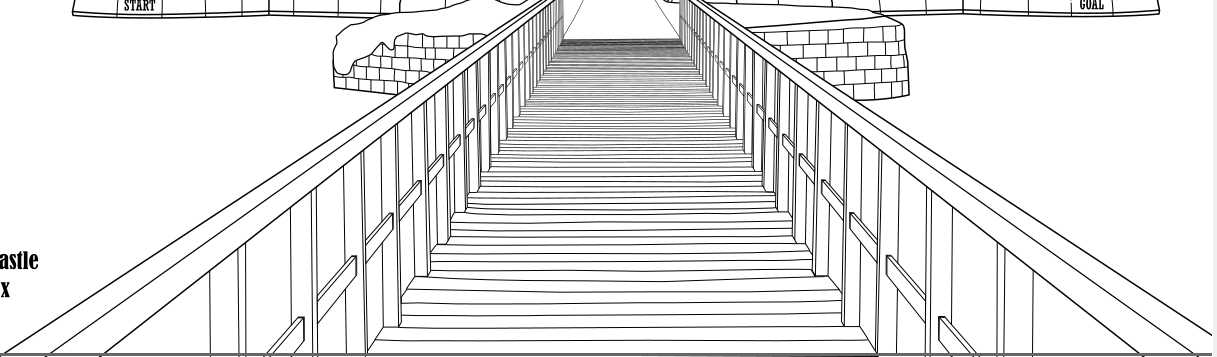
1 - Walkway - added color - different shades based on shadows; added shadow between the boards; added nails; added lines to show β€˜grain’ in the wood. Made over a dozen small fixes to extend/shorten lines and clean up the picture.

Walkway before
Walkway after

2 - Dirt Walkway - directly behind the wooden walkway it appears to be made of dirt and small stones. I gave it some detail to reflect that and colored it. I used lines closer together in the center where people would walk more.

3 - Island Bricks - I noticed that the bricks that make up the island have grout that it light colored, so as I colored the bricks, I changed the black grout to the lighter color with black accents.

4 - Island Moss - added color, including dead grass on the edges in a lighter color. I added some moss over the bricks.

Island before
Island after

Here is a close-up of 2 of the changes I made, the new bricks and the new walkway:

bricks view
pebble walkway illustration

5 - Island fix - I actually did not finish the portion of the island that goes behind the walkway. And this was not finished on either the left or right side, so I added the portion of the island in the background between the wood. I also colored them and added grout as appropriate. Here is the section on the left side with the island added. Go back and compare the before and after’s. Most people don’t notice the missing island in black and white !

bridge with background bricks illustration

6 - Door area - Added stone detail in front of the front door (and behind the pebbles) and colored it. Adjusted this from 2 sections to 1 and added shadow area near/under the door. Changed the door panels to be smaller with more accurate depiction based on the pieces of wood that make up the door. Added bolts that hold the panels together on both doors. Added a door handle on the left door. Changed the iron parts of the door to be a more accurate shape. Changed the color of the gate and added the bolts at the intersections that hold it together.

Door before
castle Door before

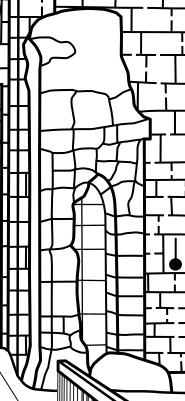
7 - Castle fixes - There are remnants of a building in front of the main castle on the right side. It has moss on the top and a door. I made the bricks the same as the island. There is a rock in front of the door. You’ll notice that later I made additional changes to this section (darker moss, doorway shadows).

Extra building before
Extra building after

The main castle has a shape that includes sections with some depth so I added color and shadows to account for that. The bricks were not as strong in the pictures I saw so I softened them just as I did on the island with the lighter cement color. The bottom stones near the boat were colored darker.

Castle illustration before
Castle illustration after

8 - Water fixes - I went for it on this section. I created relections of the castle and island in the water. Obviously I colored the water a nice blue color. I also added the reflection of the shore items (trees and grasses) after they were added.

9 - Shore fixes - Added some trees near the shore and some small hills in the background. Near the shore coming from the water I added reeds/grasses in the transition area. All items were later reflected into the water !

To show more detail I will only show the right side of the picture.

moat illustration before
moat illustration after

10 - Final touches - Added a sky. Changed the color of some moss (darker) to better reflect reality. Re-worked some layers to improve the maze. Enlarged the name of the castle in the bottom left corner larger than the location.

Considered but did not ultimately add: Clouds in the sky. I practice these often but have not perfected a good enough cloud yet. Ripples in the water. I experimented with this but decided it looked forced. Something to practice ofr future mazes. Ducks in the water and birds in the sky. Not needed, but if I could make it well enough it would be fun little added touch.

Here is the Before:

Bodiam Castle Maze in black and white

And here is the After: I had some trouble saving this as a PNG and keeping all the reflections, So I went with a screenshot. The full maze as intended is shown in the saved and downloadable pdf file.

Bodiam Castle Maze in color

How long did the changes take to add?

Changes took me almost 4 full days to complete, working on and off most of each day. I did not work on any other mazes during this time.

How much bigger is the new file than before ?

I added a lot of small details that really add up. The PDF file went from 149KB to 1,886 KB (12.6x larger) while the PNG file grew from 422 KB to 1,048 KB (2.5x larger).

Was it worth it ?

Yes, I think it was. But what do you think ?

44 Different Types of Mazes and Labyrinths

There are many types of mazes and labyrinths, with construction materials and pathway design being the main differentiators between them. Below are 44 of the most popular types of mazes and labyrinths you might find, with some really interesting maze types mixed in you rarely see. This includes both mazes in the physical world and those that are created by puzzlers for solving.

Area Mazes - Called a maze, but actually a type of logic puzzle from Japan created by Naoki Inaba. Used to teach Japan children mathematics and logic. Solving requires calculating the area of a rectangle, often multiple times. Also called Menseki Meiro. If you would like to try to solve some, online area maze can be found here.

In the below example you would first solve the wall under the # 12. You solve the equation 4 * Y = 12. So Y = 3, meaning the bottom left side of the square has a length of 3. Now you can solve using the 3 and the 21 to calculate the length of the left side of the square above the 4. Solve 3 * Y = 21. The answer is 7. Continue this to solve the Area Maze.

Area maze example

Area Maze

Arrow Mazes - Mazes where movement is determined by the direction of the arrows. One version includes mazes where you move from arrow to arrow with directional choices that are limited to a few intersections. Another version is where pathways contain arrows that can only be traveled on in the direction the arrow points. Here is an example of each different version: For the example on the left once you move from START you follow the pathway until a choice needs to be made. On the example on the right you cannot be a salmon and go down a pathway against the arrows.

If you are interested in How to Make an Arrow Maze, including a video of one being made, additional Arrow Maze examples, or Arrow Maze Books, I have that covered.

Arrow Maze #38
Arrow Maze version 2 - Cannot take paths against an arrow

Arrow Maze version 2 - Cannot take paths against an arrow

And here is an example of a third version which I call a Slide Arrow Maze. It is much more difficult. Landing on a slide arrow allows you to move to ANY arrow in the direction the one you are on is pointing ! Start from the red arrow and try to reach the goal. How to Make a Slide Arrow Maze step by step instructions.

Slide Arrow example

Baltic Wheel Labyrinth - A labyrinth with two entrance/exits based off of a y shaped start. One of the paths leads quickly to the center which also has two entrances/exits.

Baltic Wheel Labyrinth

Baltic Wheel Labyrinth

Blind Mazes (and assorted similar names) - A maze almost exclusively found in an online game where you cannot see the maze as you are solving it (or a very small fraction) because it is blacked out. Essentially you are solving the maze blindly and knowing where to go based on hitting/not hitting the walls. Playable examples include Maze Shadow, and Maze Shadow 2. And yes, this is an odd example, but accurate:

Blind maze

Blind Maze


Block Maze - Also known as a Block Move Maze, a maze solved by adding a determined number of blocks to create a pathway to the goal, or by moving (shifting) a determined number of blocks. I have a free downloadable 13 page booklet in my book section, and also step by step instructions on How To Make a Block Move Maze.

block move maze

Block Maze

Caerdroia Labyrinth - A type of Welsh turf maze based on the Cretan labyrinth design. In the center was usually a small hill, called a twmpath used to dancing and playing music.

Caerdroia labyrinth

Caerdroia Labyrinth

Chakravyuha Labyrinth - A type of labyrinth design from India whose center ends with a spiral.

Chakravyuha Labyrinth

Chakravyuha Labyrinth

Chess Mazes - A maze made by placing chess pieces on a chess board for 1 of 2 possible things: 1 - most commonly to train players how to visualize and develop move sets to become a better chess player, or 2 - as a less serious puzzle to be solved like a more traditional maze. Link to the top selling book by chess writer Bruce Albertson by clicking the book cover below.

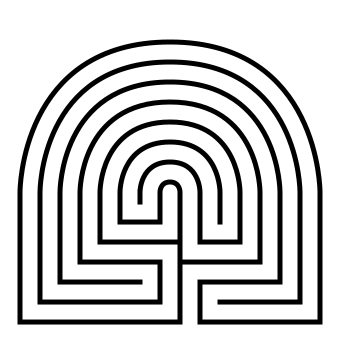
Classical Labyrinths - Labyrinths in this pattern feature a cross, a right angle and a dot in each quadrant to build the construction. Can be represented by 3, 7, 11 or 15 circuit versions. Learn how to draw a digital 7 circuit and many other types of labyrinths. Commonly used as a spiritual tool that is walked through in the physical world.

Classical Labyrinth

Classical Labyrinth

Color Mazes - Mazes where the paths that can be taken are determined by a specific order of colors. i.e. moving from red to white to blue, or by alternating colors at each junction. A type of conditional maze (definition is next below). Want to learn How to Make One ?

Color Maze

Conditional Mazes (also called logic mazes) - Mazes where movement is determined by a pre-determined pattern or rule (conditions) that must be followed in order to move in the maze. Includes math mazes, number mazes, arrow mazes, directional mazes, and color mazes.

Corn Mazes (Known as Maize Mazes in England) - Mazes whose walls are made of full grown corn stalks. Made by cutting pathways into an existing field. Sometimes corn mazes are actually made of the grain sorghum which grows similarly to corn. Best viewed from above !!

Meckley’s Flavor Fruit Farm, Somerset Center, United States, photo by Chris Bair

Meckley’s Flavor Fruit Farm, Somerset Center, United States, photo by Chris Bair

Cretan Labyrinth - Another name for a 7 circuit classical labyrinth.

Drawing Mazes - Mazes done for fun from a website like this one, or from a maze or activity book (as opposed to physical mazes like a corn maze or hedge maze). Can be hand drawn or digitally drawn. They are meant to be solved as a challenge for the solver. Learn how to draw over 40 different types of drawing mazes.

Digitally Drawn Maze

Dynamic Mazes - (also called Sliding Door mazes) - A maze type where the maze changes as you solve it. Typically this means passing over trips/switches which open and close other pathways in the maze. You can play a set of 12 different dynamic mazes designed by Jorge H Best.

Dynamic Maze

Courtesy: https://dynamicmazes.webs.com/DynamicMazes.html

Eyeball Mazes - A type of puzzle maze designed to be solved using your eyes (so no writing utensil is needed !) You can attempt 12 different versions at logicmazes.com developed by Robert Abbott. Note that to solve them JavaScript must be enabled in your web browser. Below is an example from the site. Starting at the bottom circle with eyes, you may only move to another square with the same color or same shape that you are on.

logicmazes.com eyeball maze

Hay Bale Mazes - Mazes made of stacked hay bales. It makes me feel itchy just thinking about it ! But it also looks like a great deal of fun for kids ! Watch a video showing an example here.

Hidden Picture / message maze - A drawn maze whose solution spells out a word or draws a picture in the maze. A well designed hidden maze does not show the solver the message until it is completed. Takes some practice, but you can learn how to make them ! A second type of hidden message maze is a Hidden Message Trail Maze which uses letters to spell out words instead of pathways. My example is a quote by Wilt Chamberlain.

Hidden message example with answer

This hidden message trail maze quote also contains a hint below it that gives you the length of each word.

Hidden trail message maze

Labyrinths - A pathway that does not include any junctions or choices. Reaching the destination only takes a commitment to finish. I have a whole section dedicated to making these.


Laser Mazes - Obstacle courses made of lasers where the object is to go from the start to a goal without a laser beam touching you. Sometimes these challenges are timed to compete against other solvers/friends. Think Catherine Zeta-Jones in the 1999 movie Entrapment. Check out this video of a laser maze from the Heide Park Resort. There is also a written puzzle called a laser maze where you act as if the movement through the maze is a laser bouncing off of a wall/mirror:

Kids Laser Maze


Directional Mazes - Left Turn Mazes (No Right Turn Mazes) (and vice versa) - A type of conditional maze that must be solved without taking the type of turn specified by the maze creator. Below is a left turn maze, or alternatively a NO right turn maze. Learn how to make a directional maze.

Left turn only maze example

Light Mazes - A maze created using lights to make either the pathways or the border of the maze. Example pictured: Loucen Maze in Loucen, Czechia designed by Adrian Fisher Design.

Loucen labyrinth

Phot0 from Adrian Fisher Design

On Line Maze - The below maze is also an example of a drawn maze that is solved by traveling on the line instead of between them (as in a typical drawn maze pathway). The above Directional Maze is also an on line maze, as is the regular example below that does not prohibit any turns.

On Line Maze example

Line Leads Mazes - A maze (a set of labyrinths actually) where you need to determine which of many possible lines leads to a destination. The lines do not include any junctions or choices and are a continuous path that cross around each other to confuse the solver. They are probably the easiest type of maze to make, but if you need help.

Line Leads Spider Maze

Logic Mazes (also called Conditional mazes) - Mazes where movement is determined by a pre-determined pattern or rule that must be followed in order to move in the maze. Includes math mazes, number mazes, arrow mazes, and color mazes.

Man in the Maze Labyrinth - Created by the Tohono O’Odham or Papago Indians of the Central Valley in Arizona in the United States. Used as a symbol for the tribe that can convey a variety of meanings depending on the family, usually dealing with the paths one takes in life.

Man in the Maze Labyrinth

Man in the Maze labyrinth

Math Mazes - A maze where the path taken next is determined by solving a math problem and moving in the direction of the correct answer. Perfect to keep students engaged and actually a maze that needs some strategy to create a good one. Also unique because it is a maze where it is possible for a solver to incorrectly reach the goal, but that is why teachers grade papers. I also have a section of pre made math maze templates.

Math Maze order of operations

Meandering Labyrinth - A labyrinth whose path follows the classical Greek key pattern. For some this can also describe a pathway that literally meanders in a seemingly random pattern. Think of a pathway than runs around a public park. Version 2 below:

Meandering Labyrinth

Mirror Mazes - Mazes where the walls are made of mirrors to confuse the solver and disorient their direction while they attempt to solve the maze. Often found in fun-houses. Also a plot device in many horror movies. You can have fun watching videos on YouTube showing these, like this one.

Mosaic Mazes (and labyrinths) - most commonly found in churches in Italy and France and often done as a labyrinth. It is believed that the labyrinth helped ward off evil spirits and so you would typically find this mosaic artwork at an entrance. Below is a drawing of a mosaic labyrinth.

Mosaic labyrinth

Number Mazes (also known as a Counting Maze) - Mazes where moving thru them is determined by a pre-determined numerical pattern. i.e. counting by 2’s, using only odd numbers, counting by 7’s. A type of conditional maze that is fun to make. Make a great addition to children’s activity books.

Count by 7's Maze

Painted Mazes - Exactly what it sounds like. Mazes created on canvas, paper, pavement, or stone using paint. Of course this can also be a painted labyrinth.

Panel Mazes - Mazes where the barriers are made by panels, often made of wood, but can be of other materials like plastic. The panel design allows the walls to be transported and moved between locations and also allow the maze pathways to be changed periodically to encourage repeat but new experiences. These mazes were popular in Japan in the 1980’s. Check out this wonderful video showing a panel maze:

Paving Stone Mazes - A Maze designed with paving stones or bricks for paths. Can be stone only or be mixed with turf/earth to create boundaries. If made with stones only different colors of stones are used to represent paths vs. walls. A company that specializes in this type of maze is The Labyrinth Company.

Picture Maze - A drawn maze that looks like a scene/picture but actually contains a maze to complete within the picture. Sometimes considered β€œMaze Art”. Here is my picture maze of the Playhouse Square sign in Cleveland, Ohio. The full larger version (with free download) is available on this site !

Playhouse Square Sign Maze

Puzzle Maze - A type of logic maze where the solver must use a key to determine the direction you can move within the maze. Part puzzle, part maze. Learn how to make a puzzle maze. The below example has simple movements, but they can be much more complex.

Puzzle maze example

Sand Mazes/Labyrinths - Temporary mazes/labyrinths drawn in the sand, typically on the beach for recreation and spiritual practice. Most commonly these are labyrinths used for meditation walking.

Santa Rosa Labyrinth - A labyrinth design by Lea Goode-Harris that consists of 8 concentric circles. You can learn more about it’s creation.

Santa Rosa Labyrinth

Stone Labyrinths - Formed by the careful placement of large stones in a labyrinth pattern. Over 300 stone labyrinths exist in Sweden where they are most common, with a few more scattered in nearby Scandinavian countries.

Tilted Maze - A type of conditional maze where you imagine yourself tilting the maze (pretend you are a marble inside the maze), and then moving in the direction chosen until you reach a wall. Each tilt takes you to a new wall until you reach the exit.

Tilted Ball Mazes - A physical maze typically hand held that is solved by tilting the maze to maneuver a small ball or marble from the start to a goal. A classic game that makes a wonderful gift for a maze lover ! You can watch a tilted ball maze video here as an example.

Turf Mazes - Historically mazes (despite the name these are almost always labyrinths !) made of earthen mounds that were common in England and Wales, though few remain today. Can also be temporary and cut into a lawn with a lawnmower.

Water Mazes - A type of maze used by scientists to test rodents, which are timed during their swim in the water. The 2 main types of Water mazes are the Cincinnati Water Maze (used to measure how fast the subject escapes the maze) and the Morris Water Maze ( Wikipedia: β€œIt is widely used in behavioral neuroscience to study spatial learning and memory.). The CWM is considered superior by many because you can count the numbers of mistakes the rodent makes over time.

Noldus Cincinnati Maze

www.noldus.com

Weaving Mazes - Mazes that have paths that go over /under each other in a weaving like pattern, giving a maze drawn on a piece of paper another dimension to work with. I like making these mazes so much I published a book of them, have written about How to Make a Weaving Maze and have a few more examples on the site. Some versions of this maze also include mini arrows at the under/over intersections (but generally I do not think they are needed). Another version of this is the Pipe Maze which themes the pathways !

Weaving Pathway  Maze