I was surprised to see this query pop up while I was doing some research for another blog post and I though I would take some time to answer it. Now I am going to do this the long way and the short way. And I will be nice and start with the short way first:
A maze is harder than a labyrinth.
If the answer was all you needed, thank you for stopping by. If you want to get into the long version with details, read on.
For many people, including myself, this question seems odd. It is obvious that a maze is harder than a labyrinth. But I want to explain a bit about why some people may ask the question…and the first clue comes from languages around the world. I’ll give some examples using an online translator.
Romance Languages:
English to Spanish. Maze is laberinto, while labyrinth is laberinto.
English to Italian. Maze is labirinto, while labyrinth is labirinto.
English to French. Maze is labyrinthe, while labyrinth is labyrinthe.
English to Romanian. Maze is labirint, while labyrinth is labirint.
I have friends who speak all of these languages and when they ask me about this website for the first time it always leads to confusion. Romance languages seem to have one word for both a maze and a labyrinth although I did not test all of them.
Slavic Languages:
English to Russian. Maze is лабиринт, labyrinth is лабиринт.
English to Polish. Maze is labirynt, labyrinth is labirynt.
English to Czech. Maze is bludiště, labyrinth is labyrint.
Finally, we have a winner ! Most Slavic languages follow the same pattern except for Czech ! I imagine Czechs feel the same way I do at the maze/labyrinth question.
Sino-Tibetan Languages:
English to Mandarin. Maze is 迷宫, labyrinth is 迷宫.
English to Cantonese. Maze is 迷宮, labyrinth is 迷宮.
I’ve made my point. The confusion between a maze and a labyrinth is rooted in languages that use one word for two different concepts. I could go on with languages that have two different words like Thai, and those that have one word like Icelandic. The skew in all languages is towards 1 word (fun side quest - can you guess a language that uses 2 different words). If you want to try it yourself I suggest translating the phrase “maze or labyrinth” to see the results side by side.
Maze and Labyrinth Definitions:
A maze is a complex network of paths or passages designed to confuse, often used as a puzzle or for amusement.
A labyrinth is a single, non-branching pathway leading to the center and back which has no choices to make or dead ends. It is not made to confuse, but is often used for reflection.
Now, if you look up these definitions in the dictionary they will both use the other word in the definition to describe the other. Here is an example from The American Heritage® Dictionary of the English Language, 5th Edition:
labyrinth (1) An intricate structure of interconnecting passages through which it is difficult to find one's way; a maze.
and interesting enough, the second definition has been around for centuries:
labyrinth (2) The maze in which the Minotaur was confined.
Yes, Theseus did not enter a labyrinth, he entered a maze, otherwise how would he have gotten lost ? So the words are used often used interchangeably, but I wonder if this was just a bad translation into English centuries ago that we are still stuck with.
I had an employee who had a last name that I mis-pronounced for 2 years and they never corrected me. It still feels awkward to this day. I wish they had spoken up and told me the first time I said it wrong. I admit, it is not like you use a co-worker’s last name often (or at least I didn’t). After 2 years I changed how I said it. The story of Theseus and the Minotaur has been around since Homer wrote about them in his epics in the 8th Century BCE. I think it’s too late to change Theseus entering a maze instead of a labyrinth after almost 3,000 years. So the confusion is most likely to continue for this reason alone.
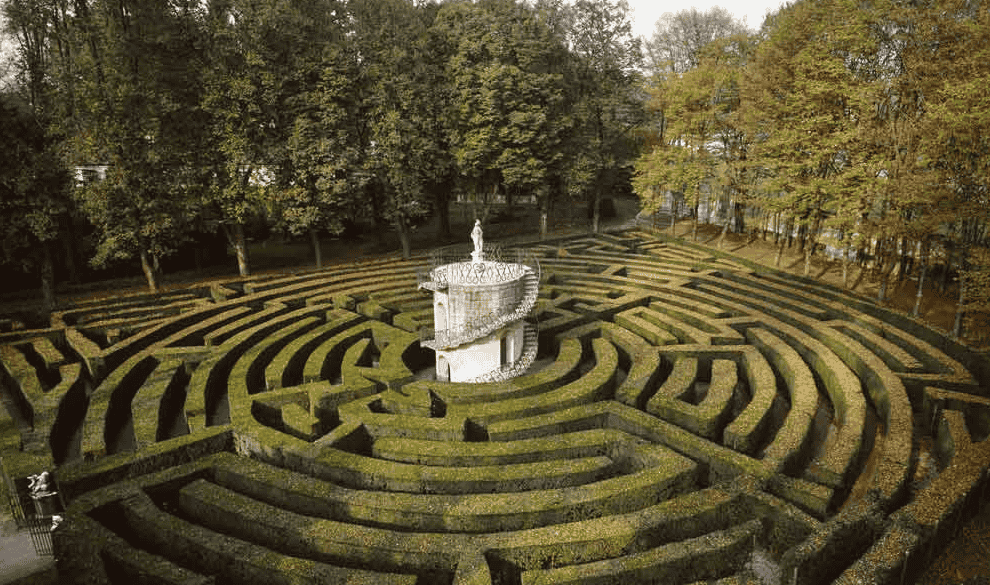
A modern example, and there are many, comes to us from the Villa Pisani Labirinto in Stra, Italy. It is commonly referred to as the Villa Pisani Labyrinth, but I wonder if that is just a bad translation because the Italian language has only one word as we discovered previously. This is definitely a maze:
Am I guilty ?
Uh. Well this website is primarily dedicated to making mazes and maze art, but I do delve into labyrinths also. I have an extensive collection of writing on how to draw labyrinths, visiting labyrinths, book reviews on labyrinths, and labyrinth gifts to name a few of the topics I’ve covered. But I always use the terms maze and labyrinth correctly so I plead not guilty.
Visual Examples: Mazes and Labyrinths
I made this simple illustration for an old post that needed a similar explanation. Just a simple square labyrinth beside a maze with the same square border. The labyrinth is a simple unicursal pathway while the maze has a few branches and choices to make.

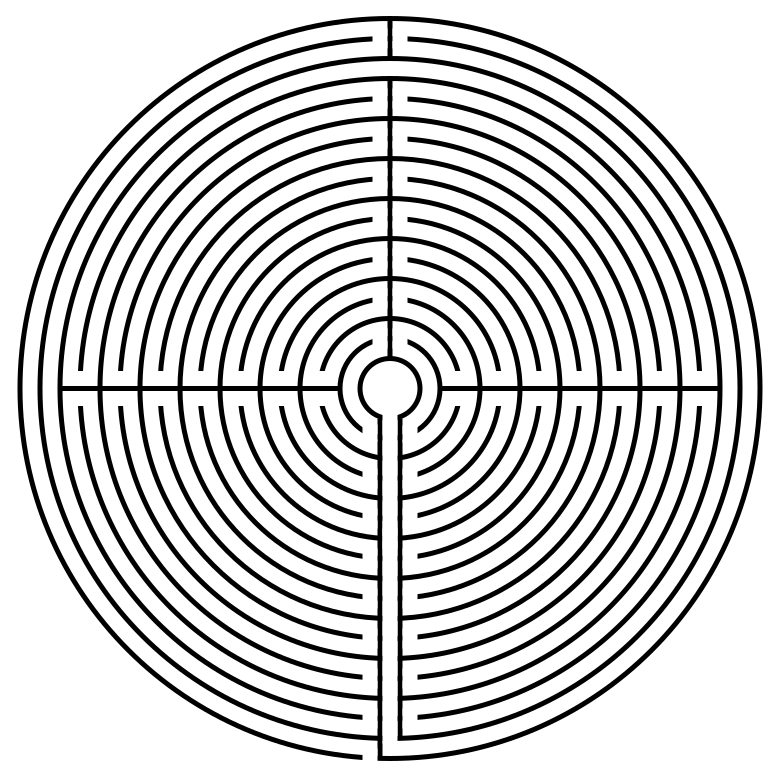
Now as far as the question at hand, each of those are simple, but technically the maze is slightly harder. But when we add scale….the labyrinth has no complexity with increased size, while the maze can get ever and ever more complicated. Here is a 17 Circuit Circular Labyrinth. If this was in the real world, solving it would mean a long walk, but you would not get lost. You just need to keep walking to reach the center.
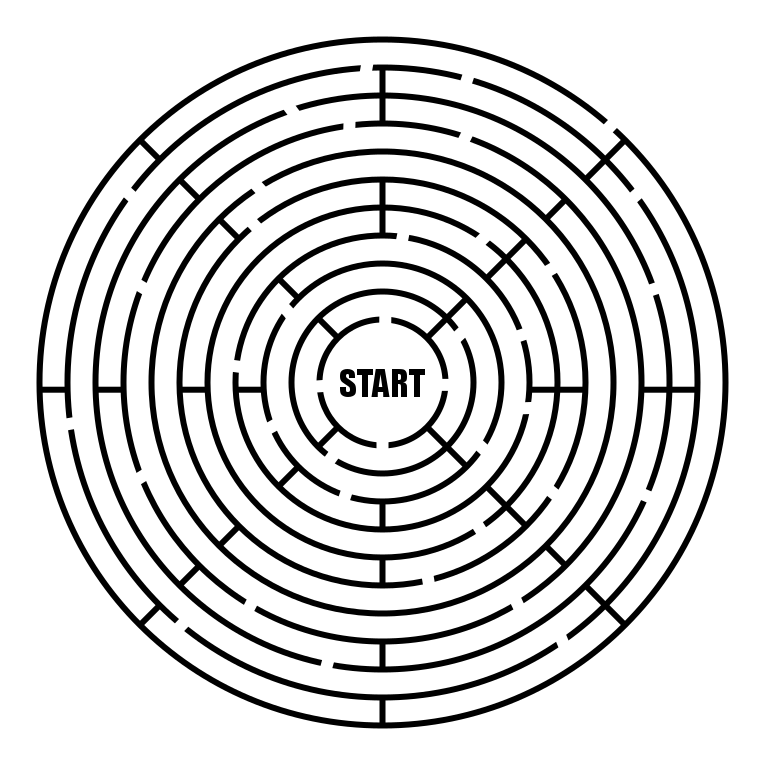
And here is a circular maze I made for kids on the site. It has only 10 layers but is still much more complex than the labyrinth. I reversed the walking direction, but the concept is the same. If this was built in the real world as walls (with this view being from above), you would get lost on your way out of the circle.
I have written about this topic in similar posts where I had a bit of fun. In the post Is There a Difference Between a Maze and a Labyrinth ? I give my 16 rules to determine if something is a maze or a labyrinth. I wasn’t too serious with the examples but you may enjoy reading it despite the overlap it shares with this post.
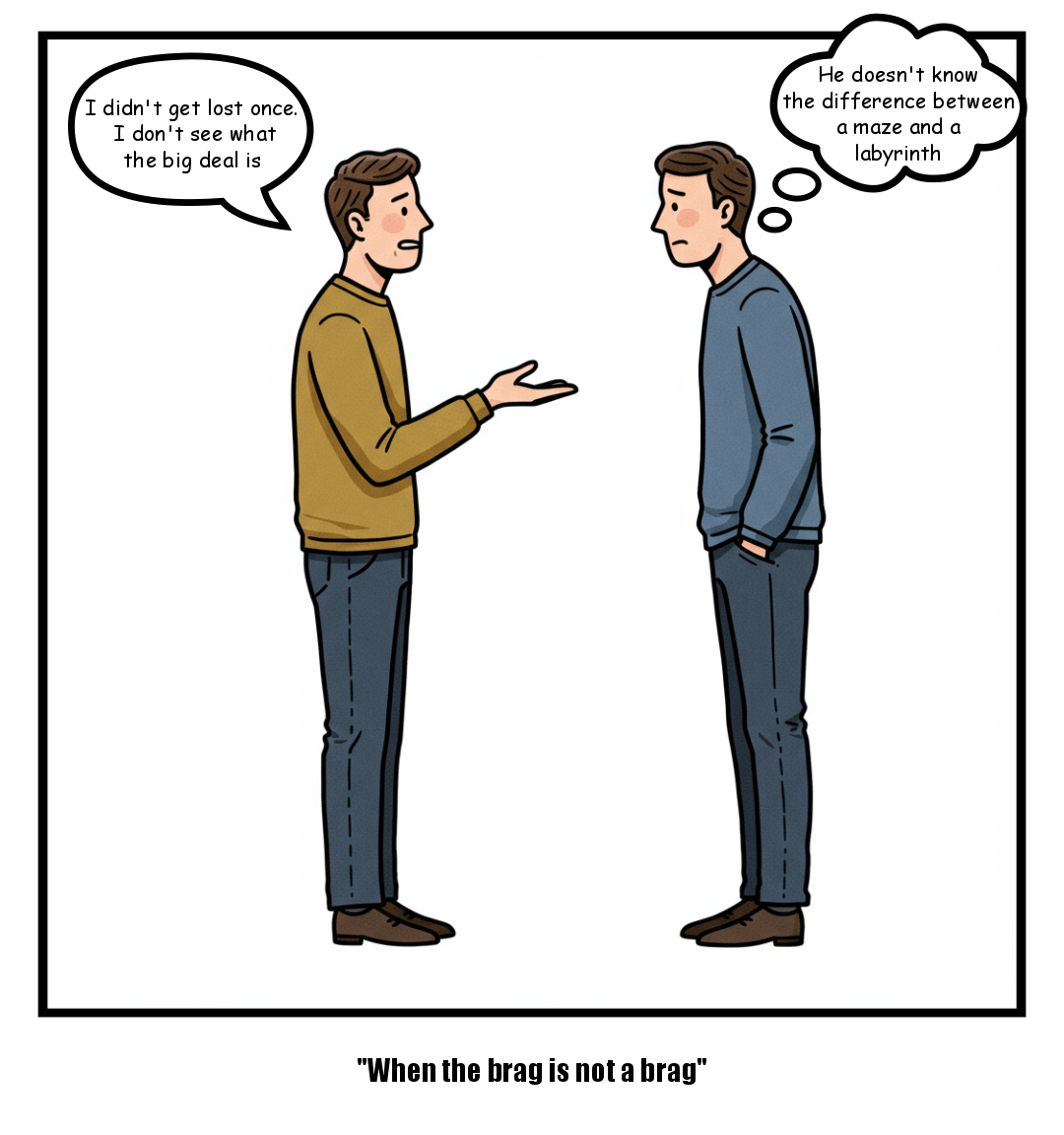
I decided to make a weekly comic strip all about mazes and labyrinths. This comic strip that I think illustrates the confusion well:
Conclusion:
A maze is harder than a labyrinth. In English, we have 2 words with separate meanings. Let’s use them. For non-English speakers, time to create a new word for your language. Words get borrowed all the time between languages. I suggest maze.
Other questions I have answered:
Is There a Difference Between a Maze and a Labyrinth ?
Can AI Generate Mazes? We Tested 12 AI Art Generators to Find Out
How to draw a maze ? (over 40 different styles to choose from)