Drawing a classical 3 circuit square labyrinth is both easy and fun once you learn the starting pattern and the rules of building the pathways. Follow this simple 5 step process and draw your own 3 circuit classical square labyrinth.
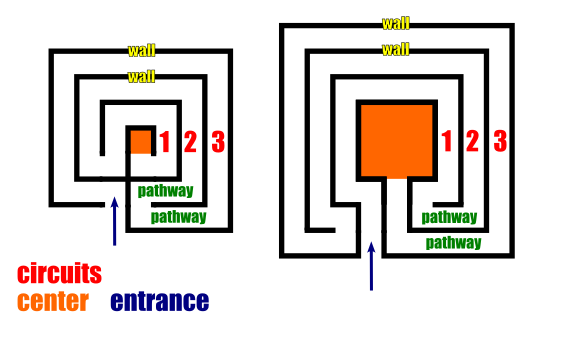
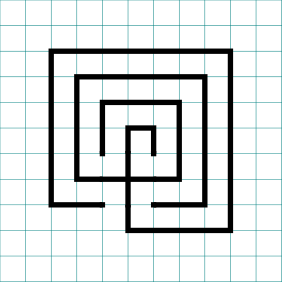
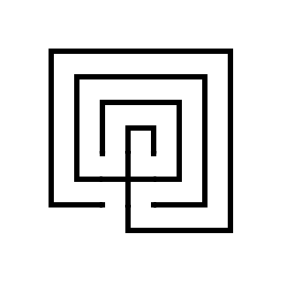
Before we get into the step by step process let’s look at the 2 different square labyrinth versions you can learn in this post. The main difference between the 2 options are the size of the center goal. The walls, pathways and circuits are all basically the same. The small center version also is not a symmetrical square. The 2 labyrinths use different seed patterns. Personally I prefer the right, perfectly square version. We will learn how to make that first in Parts 1/2.
Here is the structure of blog post:
PART 1: MAKING A SQUARE LABYRINTH (LARGE CENTER VERSION)
PART 2: MAKING A SQUARE LABYRINTH (GRIDS SHOWN)
PART 3: MAKING A SQUARE LABYRINTH (SMALL CENTER VERSION)
PART 4: MAKING AN ALTERNATIVE SQUARE LABYRINTH (GRIDS SHOWN)
PART 5: REAL WORLD LABYRINTH EXAMPLES
PART 1: MAKING A SQUARE LABYRINTH (LARGE CENTER VERSION)
Step 1: Draw the starting seed pattern.
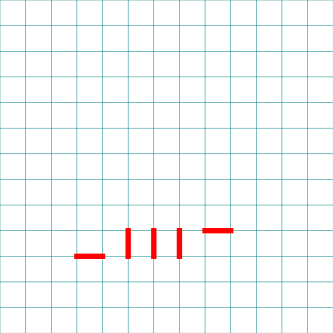
The starting seed pattern for this labyrinth is not the typical plus sign you may be used to. Instead it is 3 vertical lines, with 2 horizontal lines. The horizontal line on the left aligns with the bottom of the 3 vertical lines, while on the right side it aligns with the top of the vertical lines. Each line is the same length. See below:

3 Circuit Labyrinth Square starting seed pattern
Step 2: Draw the center goal
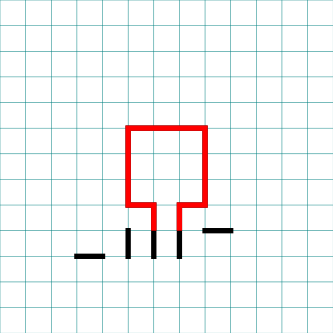
At the 2 rightmost vertical lines draw a line up one grid. This will become the opening to the center goal. Draw a square centered on top of this. Grid-wise this is a 3x3 square.
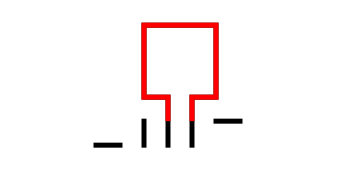
3 Circuit Square Labyrinth - Step 2 - Draw the Goal
Step 3: Draw the next level
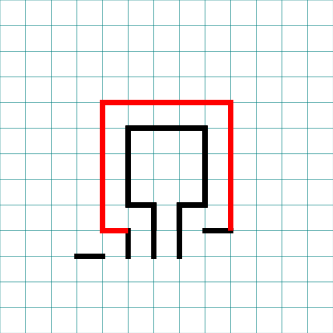
Connect the top of the remaining left vertical line to the far corner of the right horizontal line. It is an upside-down squared U shape started with a small horizontal move on the left side. See below.

3 Circuit Labyrinth - Step 3 - Draw the next arch
Step 4: Draw the next level
Connect the left side of the horizontal line around the structure clockwise until it reaches the end of the rightmost vertical line. Again this creates an upside-down square U shape plus a horizontal connection in the last section. See below.
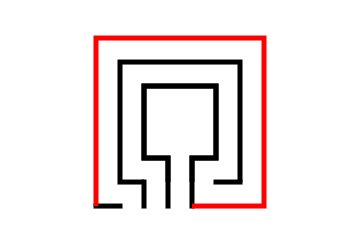
3 Circuit Square Labyrinth - Step 4 - Draw the next arch
Step 5: Connect the final arch from the left
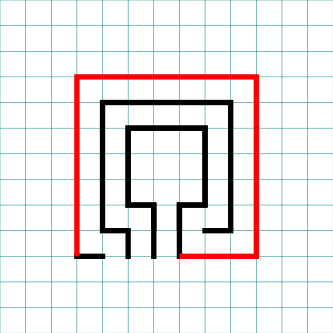
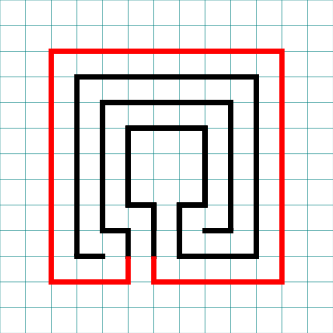
Connect the ends of the bottoms of the final 2 vertical lines around the structure to complete the labyrinth.

3 Circuit Square Labyrinth - Step 5 - Draw the final arch
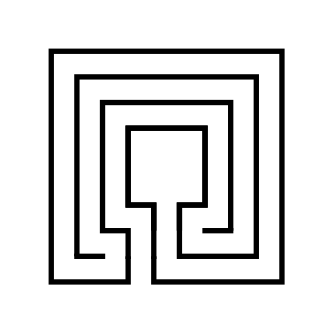
That does it. The final 3 circuit classical square labyrinth after 5 easy steps !!!

3 circuit classical square labyrinth
PART 2: MAKING A SQUARE LABYRINTH (GRIDS SHOWN)
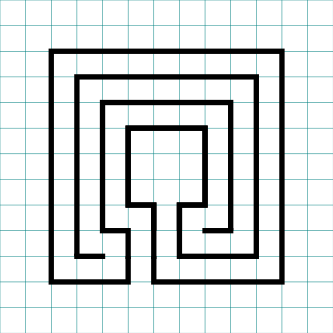
And here is the same labyrinth shown being made with grids so you can understand the shape better. Use the controls to build the labyrinth step by step.
PART 3: MAKING A SQUARE LABYRINTH (SMALL CENTER VERSION)
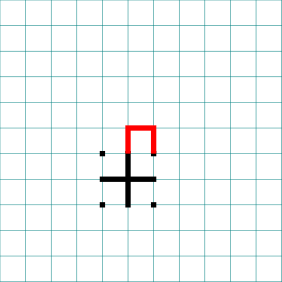
Alternative construction option: You have the option to use the more traditional starting seed pattern to create a 3 circuit square labyrinth, but this is not the most common construction. This version does not have a large square center and ends up not even being a perfect square. Here is the 5 step process to create it.
PRO TIP: this is the same construction and instructions as a 3 circuit classical shaped labyrinth but instead of curving the corners you draw the lines and corners at 90 degree angles !
Step 1: Draw the starting seed pattern.
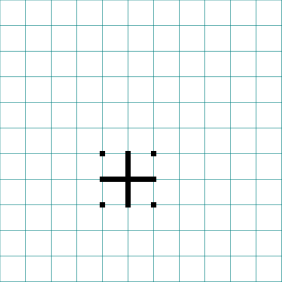
The starting seed pattern is a plus sign with four dots in each of the four corners in the space apart from the lines to form pattern below.

Step 2: Connect the first “arch”
Draw an upside -down U shaped line from the top of the plus sign to the dot in the top right corner of the starting pattern. The top of the arch should peak halfway between those two points. This line will form what will become the goal of the labyrinth.

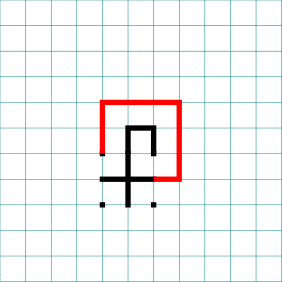
Step 3: Connect the next “arch” from the left
Draw an upside down U shaped line from the left corner dot to the end point on the right side of the plus sign. Space the line an equal distance from the wall to the inside. Notice that you have moved one point to the left and connected that to the next point on the right.

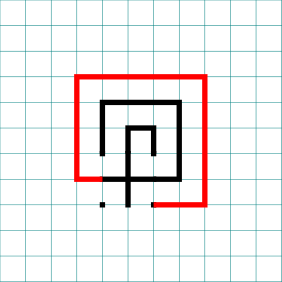
Step 4: Connect the next “arch” from the left
Draw another clockwise line from the end point of the left side of the plus sign around to the dot on the bottom right side of the pattern (Again, the next on the left to the next on the right). Space the line an equal distance from the wall to the inside as you draw the line. Again this looks like an upside-down U plus the connections to the appropriate ends.

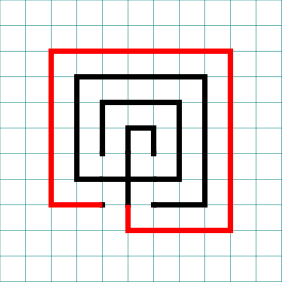
Step 5: Connect the next “arch” from the left
Same process as before but this time you connect the bottom left dot from the seed to the bottom of the plus sign.

That completes the process for this alternative version.

PART 4: MAKING AN ALTERNATIVE SQUARE LABYRINTH (GRIDS SHOWN)
And here is the same labyrinth shown being made with grids so you can understand the shape better. Use the controls to build the labyrinth step by step.
PART 5: REAL WORLD LABYRINTH EXAMPLES
Here are some examples of some 3 circuit square labyrinths you can find in the US:
The North Parish Unitarian Universalist Church Labyrinth is located in North Andover, MA and is a contemporary labyrinth version. This labyrinth is made with pavers and looks great.
The Kapp and Kappy B&B – Violet’s Venom Brewery Labyrinth is located in Kissimmee, FL and uses the large center version you learned to make in parts 1/2 of this post. This one is also made of brick pavers.
If you are interested in more real world labyrinths, I did a large research project about labyrinths in the USA. If you are interested in knowing things like what the largest labyrinth is in the US, where the Northernmost, Southernmost labyrinths are in the US, and similar questions (about 30), it is worth a read: Questions about US Labyrinths Answered.
Other posts you may like:
The 8 best books about mazes, labyrinths and their history
10 of the Most Frequently asked Questions about Labyrinths, with Answers