A Collection of Maze Design Case Studies to improve your Mazes

This post is meant to pull together all of my case studies on making mazes for easy reference. As I add new case studies, this post will be updated. There are over 30 posts to read, but I have organized them into larger sections to help get you to the content you are interested in easier.


In my very large section on How to Make a Maze I include a post on maze art which includes a case study at the end to illustrate the post:

How to Create Maze Art in 6 Easy Steps + Case Study


The first set of 6 case studies show a maze that I did not like, then I worked on them to improve them for the site:

Case Study#1 - How to Improve a Bad Maze - Tiki Totem Maze

Case Study#2 - How to Improve a Bad Maze - Danzante Conchero Chichimeca Maze

Case Study#3 - How to Improve a Bad Maze - Red Rocks Amphitheatre Maze

Case Study#4 - How to Improve a Bad Maze - The Hollywood Sign

Case Study #5 - How to Improve a Bad Maze - Severance Hall

Case Study#7 - How to Improve a Bad Maze - Ship

The next set of 6 case studies show a maze that I considered to be good, but I still took steps to improve them. They were all inspired by a blog post about improving existing maze art, Maze Art: Advanced Tips to Creating Your Own Masterpiece.

Maze Art Case Study - Bodiam Castle Maze Coloration & Improvement

  • I wanted to give you an example of what this looks like in practice. The before on the left side and the after on the right side:
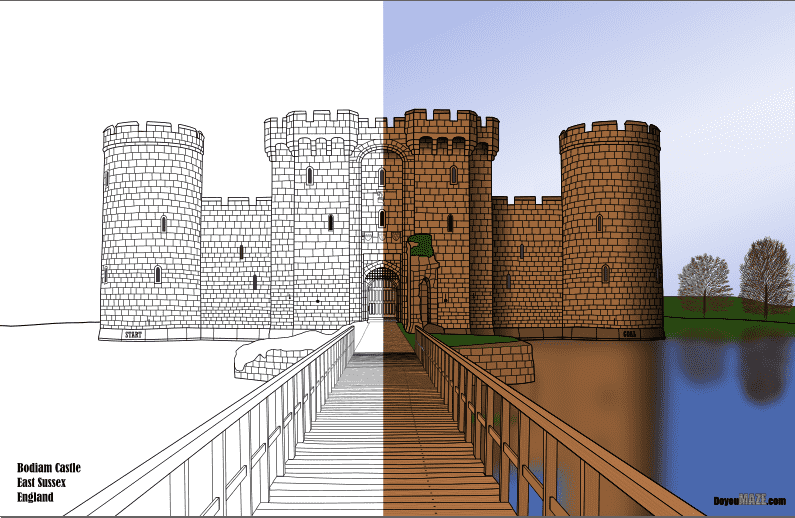
Half and Half maze example

Case Study#6 - How to Improve a Maze - Uxmal

Case Study#8 - Improving Previous Mazes

Case Study#9 - Improving a Maze - Taj Mahal

Case Study#10 - Improving a Maze - Templo de Sangre de Cristo

Maze of the Week #65 - Bridge Guardian Maze

In 2025 I decided to go back and improve many of my earlier mazes of the week. Here is the long list of mazes I touched:

Maze of the Week 10 Redux - The Alamo Mission (MOTW #158)

Maze of the Week 42 Redux - Sydney Opera House - (MOTW #159)

Maze of the Week 3 Redux - Museum of the North (MOTW#160)

Maze of the Week 45 Redux - Air Force Cadet Chapel (MOTW#161)

Maze of the Week 38 Redux - Hoover Dam (MOTW #162)

Maze of the Week 27 Redux - Lincoln Memorial (MOTW #163)

Maze of the Week 8 Redux - Abraham Lincoln Maze (MOTW#164)

Maze of the Week 99 Redux - Berlin Planetarium (MOTW#165)

Maze of the Week 94 Redux - BMW Welt (MOTW# 166)

Maze of the Week 39 Redux - Spaceship Earth at Epcot Center (MOTW#167)

Maze of the Week 13 Redux - Clayton Theatre (MOTW #168)

MOTW# 25 Redux - National Center for Human and Civil Rights (MOTW#169)

Maze of the Week 23 Redux - Wrigley Field Sign (MOTW#170)

Maze of the Week 59 Redux - QRO Walking Street (MOTW #171)

Maze of the Week 49 Redux - Chich'en Itza (MOTW #172)

Maze of the Week 64 Redux - Leeds Castle (MOTW#173)

Maze Redux - Darth Vader (MOTW#174)

Maze of the Week 77 Redux - Giraffe (MOTW #175)

Maze of the Week 79 Redux - Severance Hall (MOTW#176)

Maze of the Week 46 Redux - The Free Stamp (MOTW#177)

Maze of the Week 75 Redux - Peter B Lewis Building (MOTW#178)

Maze of the Week 92 Redux - Kresge Auditorium (MOTW #179)

Maze of the Week 91 Redux - Monte Alban (MOTW#180)

Maze of the Week Re-Dux #56 - Matrimandir at Auroville Maze (MOTW#181)

Maze of the Week Re-Dux #36 - Key West Buoy (MOTW#182)

And finally we have case studies on specific maze design topics that I pulled together:

Case Study#11 - Making Mazes with Shadows

Using Color for Maze Pathways - A Case Study

Maze Solving Case Study - Using the Reverse Fill Solving Method

Case Study - Making Maze Art in 3 Different Difficulties

Case Studies on Specific Maze Types:

Creating a Hidden Maze - Case Study #1

Maze Design Case Study - Designing a Grid Maze in Different Difficulty Levels

Arrow Mazes got a 14 part masterclass blog post that is either for you or not. If you have never tried an Arrow Maze, I suggest you do !:

The Arrow Mazes Design Masterclass: 14 parts, 50 examples

I also did a 3 part series to help you invent your own maze types. While these are not case studies I believe the content fits here well:

Part 1 - Options for Starting and Ending a Maze

Part 2 - Maze Pathway options

Part 3 - Conditional Pathway options

I did a 25 week project where I took one maze and then designed it 100+ ways to show how a single maze could look so different based on your choices.

One Maze - Many designs - Final recap

10 Frequently Asked Questions About Mazes with Answers

Here are the 10 most frequently asked questions about mazes. I am going to attempt to answer each. First the list of questions.

  1. What is a maze?

  2. What are the different types of mazes?

  3. How did mazes originate?

  4. What are the benefits of solving mazes?

  5. How do you solve a maze?

  6. What is the world's largest maze?

  7. What is the most difficult maze in the world?

  8. What is the difference between a maze and a labyrinth?

  9. Why are mazes so popular?

  10. What is the future of mazes?

If you got tripped up on question #8, you might prefer the blog post:

10 of the Most Frequently asked Questions about Labyrinths, with Answers

Here are some additional details about each of these questions, with answers to each ! :

What is a maze?

A maze is a complex network of paths that are designed to be difficult to navigate. The goal of a maze is to navigate through the network of interconnected paths, avoiding the dead-ends along the way. Mazes can be made from a variety of materials, including corn, wood, stone, hedges, or drawn on a piece of paper.

What are the different types of mazes?

There are a few ways to answer this question:

  • There are two main types of mazes: unicursal mazes and multicursal mazes. Unicursal mazes have only one path that leads from the beginning to the end and they are called labyrinths. Multicursal mazes have multiple paths that can lead to the end, with some paths leading to dead ends.

  • Or, you can look at all the different types of labyrinths and mazes I rote about in my blog post 44 Different Types of Mazes and Labyrinths. That list includes things like what a Caerdroia Labyrinth is, or an Arrow Maze, or a Tilted Ball Maze, each with examples !

  • Or, you can categorize mazes as existing in the physical world (like a corn maze, hedge maze, water maze, laser maze) or mazes that are on a piece of paper and shown from above.

How did mazes originate?

The earliest mazes were created in ancient Egypt and Greece. The first recorded labyrinth comes from Egypt in the 5th century BC (labyrinths were seen before mazes). They were often used for religious rituals and as symbols of the journey of life. Mazes were also used in ancient Rome as training grounds for soldiers. Mazes did not become popular until during the Renaissance when the first garden mazes appeared in Venice, Italy.

What are the benefits of solving mazes?

I think think is a common search because you want to believe that solving mazes is difficult, but enjoyable and you think to yourself- wait - this must be healthy right ? I found that there are 6 Benefits of Solving Mazes that you can read about in the link or just use this list: 1. Improves Problem-Solving Skills 2. Enhances Spatial Recognition 3. Boosts Patience and Persistence 4. Builds Hand-Eye Coordination 5. Reduces Stress and Anxiety 6. Provides a Fun and Engaging Activity

How do you solve a maze?

There is no one-size-fits-all answer to this question, as the best way to solve a maze will vary depending on the type of maze. Personally, I came up with 8 methods, 4 each depending on what type of maze it is, physical or seen from above (on a screen or on paper for example). You can read about the options shown in the summary below in more detail in my blog post about solving mazes.

  • 8 MAZE SOLVING METHODS (STRATEGY)

    • 4 METHODS FOR PHYSICAL MAZES SOLVED FROM THE INSIDE

    • 4 METHODS FOR MAZES VIEWED FROM ABOVE

  • 5 COMMON MAZE SOLVING OPTIONS (HOW YOU DO IT)

  • 2 CHEAT CODES TO SOLVE MAZES

What is the world's largest maze?

The answer to this question changes often as new, larger mazes are always being built ! And some claim to be the largest with qualifiers that confuse (adding a very specific word - like the largest bamboo maze in the world).

Another interesting framing of this question - Do you mean largest size of the maze - or do you mean longest pathway needed in order to solve the maze ? This is how search engines get tricked into giving many different answers !

The world's largest hedge maze is the Yancheng Dafeng Dream Maze in Yancheng, Jiangsu, China. It covers an area of 35,596.74 square meters (383,160.12 square feet) and has a total path length of 9,457.36 meters (31,028 feet 1 inch). The maze is made of shrubbery and is designed in the shape of a giant elk. It took over 100 days to build and opened to the public in 2018.

What is the most difficult maze in the world?

The most difficult maze in the world is a matter of opinion, but some contenders include:

What is the difference between a maze and a labyrinth?

A maze is a complex network of paths that can have multiple solutions. A labyrinth is a unicursal maze, meaning that there is only one path that leads from the beginning to the end and if you follow the path you will arrive at your destination. Labyrinths are often used for religious rituals and meditation. I thought it would be fun to ask some questions to help you determine what you are looking at: 16 RULES TO DETERMINE IF SOMETHING IS A MAZE OR A LABYRINTH.

Why are mazes so popular?

Mazes are popular for a number of reasons. They are fun and challenging, and they can be used for a variety of purposes, including entertainment, education, and religious rituals. Mazes can also be a great way to exercise the brain and improve problem-solving skills. Mazes also give the solver something to focus on that can be meditative.

What is the future of mazes?

Mazes remain popular today, and they are being used in new and innovative ways. I explored how AI did with creating mazes and I was not impressed, but I think once they get trained, AI will create some interesting things (What I learned using AI to make maze art) . Mazes are currently being used in therapy and education, and if it works, expect that to expand. I believe that mazes will continue to be popular in the future, and I am excited to see how they are used in new and creative ways. And don’t forget gaming (The 12 Most Important Retro Maze Video Games to Lose a Day With) where we have maze games like Pac-Man and of course Minecraft. What happens in gaming as virtual reality becomes more popular ?

Posts you may like:

10 of the Most Frequently asked Questions about Labyrinths, with Answers

The Best Maze and Labyrinth Movies of all time !

Discovering 7 of the world’s most interesting mazes

The 10 Most Famous Labyrinths from Around the World

Source: Leeds Castle picture from ...