I was doing some exploring as I wrote a series of articles on the use of AI and creating mazes and found a paper from July 2007 on Image-Guided Maze Construction. The authors were Jie Xu and Craig S Kaplan from the University of Waterloo. Basically they looked into creating maze art using algorithms and computer graphics. They did a wonderful 25 minute video explaining the concept which is worth watching. You can find the video and read the paper (it is 10 pages and includes some great illustrations) at this link. While I cannot use the illustrations from the paper I can use my own work and research to show you what it says. Figure 13 is of particular interest where they convert a photograph of a mill into a maze !
What does the paper say ?
The paper "Image-Guided Maze Construction" talks about a technique for automatically making pictorial mazes from images. The system allows the designer to manually partition an image into a set of regions and then assign style parameters to each region. They are also able to sketch a schematic layout for the maze's solution path. The final maze will contain intertwined passages in each region, connected together by breaking walls between regions. In regular language, it speaks about taking an image, then making it into a maze that looks good by using the shape of the object in the image to create the pathways.
The paper describes four different maze textures: directional mazes, spiral mazes, random mazes, and user-defined lines. Each texture is controlled by specialized parameters. The paper also describes an algorithm for building mazes that respect the layout of a given solution tree.
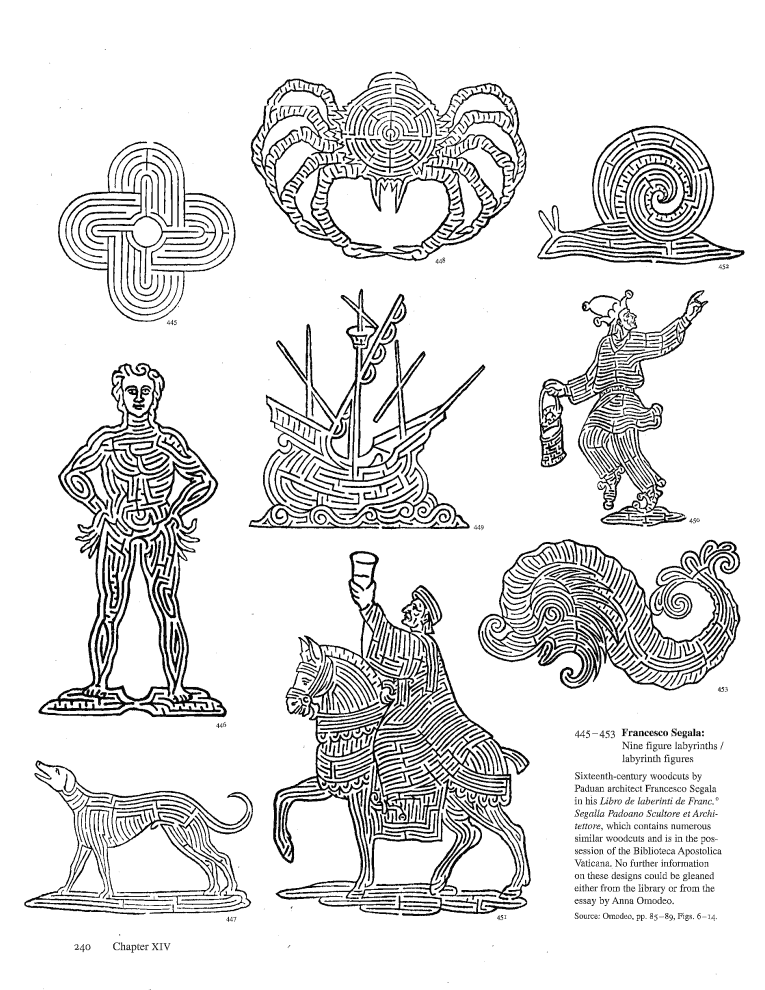
The system has been implemented as an interactive application. The paper presents several examples of mazes generated by the system, including mazes based on photographs of the Great Wall of China, a portrait, and a discus thrower. It also shows pictorial mazes (which I call maze art) from the Francesco Segala - The world's first maze artist. Here is an image of his work, also shown in the paper, but this comes from Through the labyrinth : designs and meanings over 5000 years (2000) by Hermann Kern.
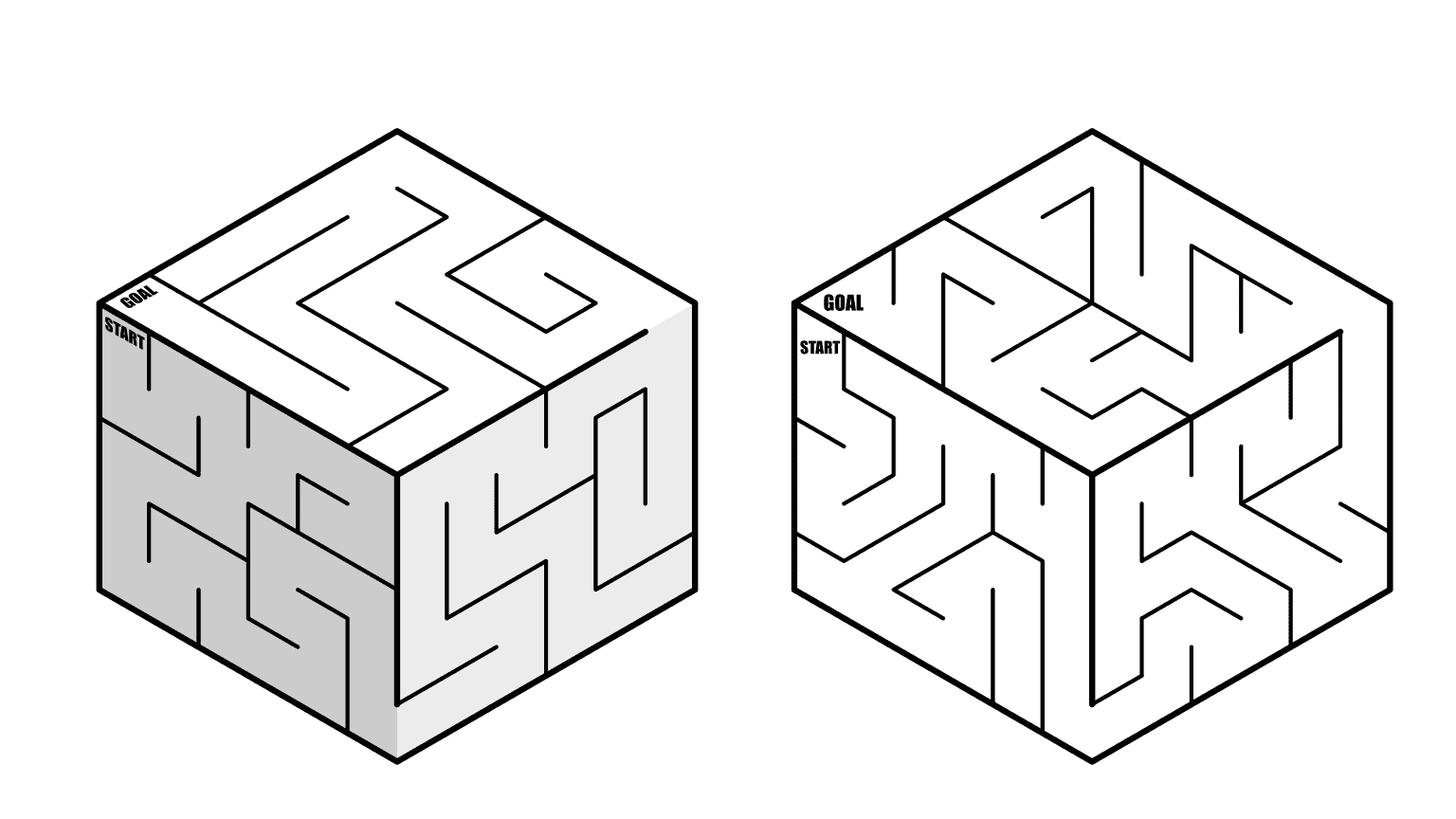
Notice how the pathways and walls match the shape of the object, enhancing the look of the maze. I recently made this example to show the good and the bad of maze construction. The left looks like a cube shape because of the light (shadow coloration), but also because of the orientation of the lines and the written START/GOAL. The right example loses the perspective with flat lettering and lines/pathways that do not flow with the object.
So why do I bring this to your attention so many years later ?
This paper was written in 2007 and came from the School of Computer Science at the University of Waterloo. I have a feeling the advancements in AI mean this could be executed now or in the near future. For some background, here are 3 blog posts I wrote and updated recently:
WHAT I LEARNED USING AI TO MAKE MAZE ART (2026 update)
Can AI Generate Mazes? We Tested 13 AI Art Generators to Find Out (2026 update)
And when you combine the ideas of those 3 posts with this research paper and I come to the following conclusion: AI will be reading things like this paper and will be making great mazes soon. I can image someone like these authors working with AI and teaching it to make maze art relatively quickly IF they want to take the time to do it. Will it change what this site looks like ? Only time will tell. Maybe it becomes the typewriter in the year 2000. Let’s hope not ! I tested Al to generate mazes in 2023, ( a minor test in 2024) and again in 2026. It continues to get better, but it is not quite ready for the challenge. The second blog post above compares 2023 to 2026 prompts directly for making mazes. Can AI learn all of the maze generating options in terms of algorithms to create actual mazes ? I speak about a few options in my post - Exploring Different Ways to Solve a Maze.
Side note: I used Starryai to generate the picture for this blog using this prompt:
“Make me a logo for a blog post titled Image-Guided Maze Construction Research paper.”
This is what starryai came up with in 2023 and now again in 2026. Notice how 2023 was an interesting abstract mazelike structure while 2026 actually fits the blog post. Most impressive is the 2026 did not use gibberish and misspelled words for the text, a common problem when using AI text to image. The mazelike brain fits the post. It’s not perfect, but it works so much better than before. Small wins in AI image generation are like compound interest on money - they pay off big over time !