
I want to speak about the world’s very first maze picture artist, Francesco Segala.
Francesco Segala (c. 1535-1592) was an Italian artist, born in Padua, Italy, who was primarily known as a sculptor and architect, but who made a unique contribution to the history of mazes and especially maze art. My research suggests he was the first picture maze artist.
Here's what is known about him:
Pioneer of Picture Mazes:
He is widely credited as the first artist to create picture mazes, which are puzzle maze designs that form recognizable figures.
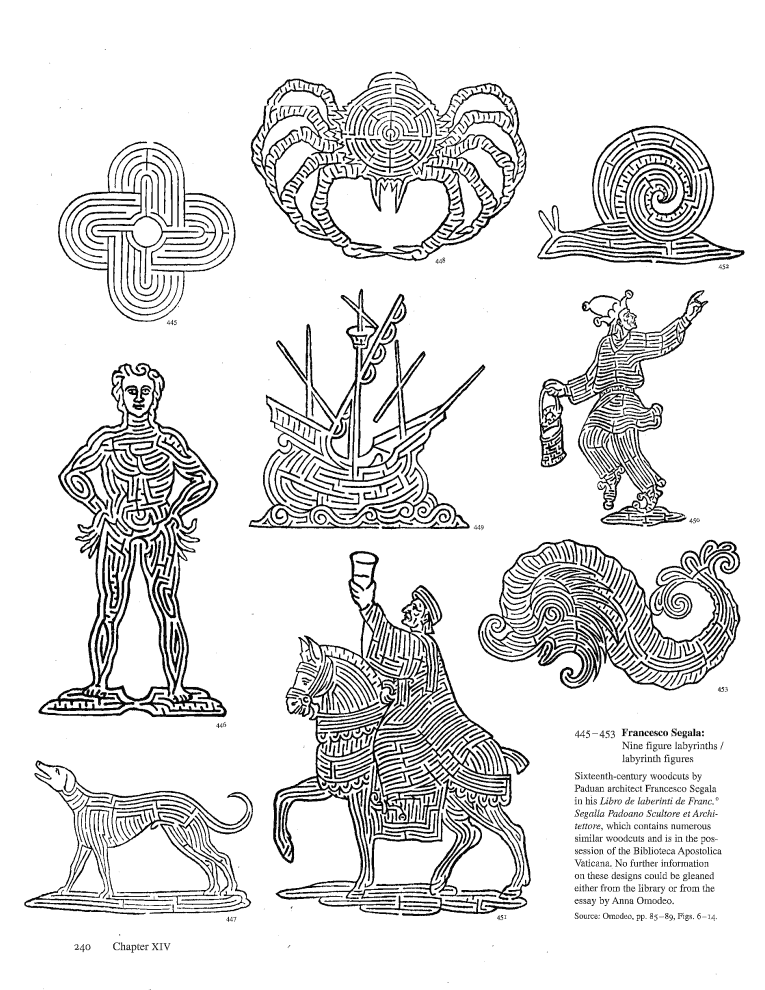
His designs included a variety of shapes such as ships, dolphins, crabs, dogs, snails, horsemen, and human figures. One notable design mentioned is a "labyrinth-man" which symbolized the pursuit of knowledge.
It's important to note that while he designed these intricate figurative mazes, it's doubtful whether many of his designs were actually constructed as physical hedge mazes. They were likely more often found as illustrations, perhaps in a "Libro de laberinti" (Book of Labyrinths) as some sources suggest. This makes his contribution more about the concept and artistic representation of such mazes rather than their physical construction.
Working primarily as a sculptor and architect meant he was always designing 3D objects. It is interesting to think how that may have inspired his drawing of objects in 2D and mazing them. Essentially isn’t that what an architect does when drawing plans ? He would have lived in a time when hedge mazes were around. A drawn maze was square or circular. He broke this barrier by using new shapes.
Here is a page from the excellent book, Through the labyrinth : designs and meanings over 5000 years (2000) by Hermann Kern AMZN, showing some of the maze art of Francesco Segala. Notice how the crab maze contains a labyrinth looking section in the center of the body :
His Sculptural Career:
Beyond mazes, Segala had a significant career as a sculptor. He trained in Venice in the workshop of Jacopo Sansovino, a prominent sculptor of the time. He was most likely never known for his mazes during his life but rather his sculptures.
He worked mainly in Venice and Padua, and also spent some years at the Gonzaga court of Mantua.
You can find a long list of his works on his Wikipedia page.
His sculptural works include (here is a link to see a few):
A statue of John the Baptist for the baptismal font in the Church of San Marco in Venice (1565).
Marble allegories of Abundance and Charity for the Scala d'Oro (Golden Staircase) in the Doge's Palace in Venice (c. 1581).
A bronze figure of Hercules (c. 1565), which has been exhibited in The Frick Collection.
A rare example of his work in colored wax, a relief portrait of Archduke Ferdinand II, is in the Kunsthistorisches Museum, Vienna (c. 1580).
He is also attributed with "Saint Matthew and the Angel" (c. 1570), a terracotta sculpture.
His Legacy:
Segala's work, particularly his figurative mazes, has inspired later artists. For example, Vik Muniz created a piece titled "Dog, After Francesco Segala" (2001), reinterpreting Segala's dog maze. You can find an illustration of it on the exhibits page.
There are many modern day maze artists. Ben Uelk, K Lars Lohn, Sean C Jackson, Joe Wos and Michelle Boggesa-Nunley are some of my favorites each with unique styles. This website also contains maze art. You can also find new maze art on the reddit maze page.
In summary, Francesco Segala was a 16th-century Italian artist, recognized for his innovative picture mazes that transformed puzzles into recognizable art forms, alongside a substantial career as a sculptor whose works can be found in significant Italian historical and religious sites. He broke the barrier on what a maze could look like and inspired later artists to follow his lead with new designs and structures.
Additional Blog Posts you may enjoy:
Which is harder - a maze or a labyrinth ?
Can AI Generate Mazes? We Tested 13 AI Art Generators to Find Out